| |
What's going on in ECAD: ARCHIVE June 2006 - July 2005
June 1-2, 2006
ECAD 13th Mayors`Conference in Vilnius
Combating Drugs - A World Challenge

Björg Månum Andersson, Norway; Jim Corr, Ireland; Paula Kokkonen, Finland; and Margareta Olofsson, Sweden |
|
Already a good tradition, ECAD 13th Mayors` Conference in Vilnius, Lithuania, was a success even this year.
The Conference went on for 2 working days, June 1-2, and was preceded by ECAD Advisory Board meeting.
The Mayor of Vilnius, Mr. Arturas Zuokas, demonstrated his true commitment to solving the drug issues and held the idea of organising this conference close to his heart.
|
160 participants came from 59 cities in 20 countries, including New Zealand, Albania and Turkey.
During the official reception at the Vilnius City Hall, the city of Oslo, represented by the Commissioner for Social Affairs, Ms. Sylvi Listhaug, signed the Letter of Intent for
the prevention programme “Youth in Europe”, enlarging for the time being the number of participating cities to 12. Bulgarian capital Sofia will sign the document on the 5th of July and Serbian capital Belgrade will follow suit later this summer.
ECAD 13th Mayors` Conference stood out for a number of thought-provoking scientific reports on abused buprenorphine (Prof. Erkki Vuori, Finland), effectiveness of needle-exchange programmes (Med., Dr. Kerstin Käll, Sweden) and corruption hindering the drug fight (Crim. Prof. Andrejs Vilks, ECAD in Latvia).
The Forum of Experts dedicated to prevention and integration of former drug addicts was quite enlivened by the innovative ideas of “Mano Guru”, an integration programme providing work and support for former addicts.
One of the leaders for another engaging prevention project for the young, “New Fashion”, Lithuanian artist Linas Karalius presented the project himself at the Conference.
Modern pop-, rock- and other trend artists and singers in Lithuania become more aware of the exemplary influence of healthy and sober life style they exercise and can propagate to young minds. After the project presentation the conference participants could enjoy short, but impressive performance of one of the project’s contributors, young and popular Lithuanian singer Sati.
ECAD thanks wholeheartedly Vilnius Mayor Arturas Zuokas and Vilnius Municipality for their regard and hospitality when organising the conference.
Next year ECAD Mayors` conference will be kindly hosted in Istanbul, Turkey, in May 2007.
|
28th of April 2006
Youth in Europe researchers meet in Stockholm

Researchers and coordinators of "Youth in Europe" prevention programme |
|
Researchers and contact persons from 13 European cities met in Stockholm at the end of April to discuss the details of the questionnaire of the drug prevention programme "Youth in Europe".
|
The project is about to enter its first practical phase in October 2006. However, to come to this very date was not that easy - sociological tradition of launching a questionnaire at schools in Helsinki, Stockholm, Sofia or some other cities differs.
One of the project leaders, Mrs. Kristin Arnadottir from the Municipality of Reykjavik, presented a Progress Report at the meeting and a coming web-site of the Programme (www.seidur.is/youthineurope).
That was followed by a great deal of practical questions to Icelandic researchers Mrs. Inga Dora Sigfusdottir and Mr. Thorolfur Thorlindsson.
The participants also described some of the main prevention initiatives practised in their cities.
A suggestion was made on the part of the coordinators to form a support team that could visit the new project signatories and tell more about the practical issues of the programme implementation. The idea seemed very reasonable for the researchers and the first tour of visits will be made in June 2006 to Vilnius, Riga, Sofia and some other cities.
At the end of the meeting, His Excellency the President of Iceland, Mr. Olafur Ragnar Grimsson addressed the participants. He shared some of his personal experiences about being the Patron of this prevention programme and spoke ardently about the importance of cooperation in the field of drug prevention.
|
19-21 April 2006
ECAD in Russia - 5 years: results and perspectives
ECAD Regional Office in Russia held its anniversary Conference at the Mariinsky Palace. These historical premises are now used for Legislative Assembly`s plenary sessions in St.Petersburg.
The anniversary conference attracted about 140 people.
Deputy mayors, Russian Federal Drug Control Service officers, university professors and students, municipal representatives from almost 30 Russian cities and autonomous republics, Helsinki deputy Mayor Mrs. Paula Kokkonen, guests from Riga Prevention Centre and Stockholm and Riga ECAD office directors stood for the strong connection within ECAD network.
|
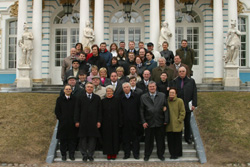 Excursion to the Catherine Palace in Poushkin, a small town near St.Petersburg
|
 Conference participants at the Grand Meeting Hall
|
|
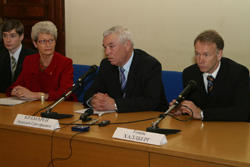 Mrs. Paula Kokkonen, Helsinki deputy Mayor and her interpreter, Mr. Arkady G. Kramarev, ECAD Advisory Board member and a member of the Legislative Assembly and Mr. Tomas Hallberg, ECAD director at the press conference.
|
 At the Russian restaurant (from left): ECAD Advisory Board members Mr. A.G. Kramarev and Mr. I.B. Matveyev, Helsinki deputy Mayor Mrs. P. Kokkonen, the Bear, ECAD Regional Office director in Russia Mr. G.V. Zazulin and Perm City Administration representative Mr. J.B. Volfovich.
|
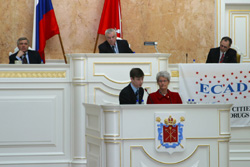
Presiding at the Conference (from left) Igor B. Matveyev, Arkady G. Kramarev, George V. Zazulin.
Helsinki Mayor Mrs. Paula Kokkonen talks about important neighbour-connections between Russia and Finland.
|
|
The Conference agenda was very tight, focusing in particular on the functions of Russian federal, regional and local legislative organs, determining their roles in state anti-drug policy.
In this respect, it seemed of utmost importance for the participants to evolve the new project of Russian state anti-drug policy Concept.
This new Concept is based on the conflict method and developed by ECAD Anti-Drug Policy Centre in St.Petersburg.
Conference participants were unanimous about the fact that the powers of municipal authorities in anti-drug policy question should be specified in Russian state laws. This legislative basis lacks today and it stands in the way of many anti-drug policy routines on the local level.
|
|
24-25 February 2006
ECAD Advisory Board Meeting in Istanbul
ECAD Advisory Board´s spring meeting took place in Istanbul last weekend. Please have a look at some of the picturesque outskirts of this vivid city, which will host ECAD Annual Mayor`s Conference in 2007.
A few flashbacks and the main events from the Board meeting follow.
|
 The view over Istanbul
|
 Famous Blue Mosque with its six minarets
|
|
 Paula Kokkonen, Deputy Mayor of Helsinki, sings Youth in Europe agreement with ECAD director Tomas Hallberg.
Margareta Olofsson, Stockholm Deputy Mayor and Dagur B. Eggertsson on behalf of the Youth in Europe Steering Group witness.
|
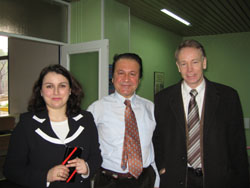 During the visit at the Alcohol and Drug Addiction Research Treatment Center in Istanbul:
Dr. Birim Danismant, Ass. Prof. Duran Cakmak, director of the Center and Tomas Hallberg, ECAD director.
During the visit at the Alcohol and Drug Addiction Research Treatment Center in Istanbul:
Dr. Birim Danismant, Ass. Prof. Duran Cakmak, director of the Center and Tomas Hallberg, ECAD director.
|
|
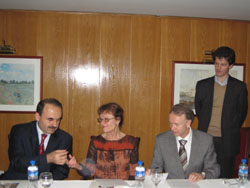 Dr.Muammer Erol, Vice-Secretary General of Istanbul Municipality signs Youth in Europe agreement together with the Deputy Mayor of Stockholm, Margareta Olofsson and ECAD director Tomas Hallberg.
One of the chair pesrons of Youth in Europe Steering Group, Dagur B. Eggertsson witnesses.
|
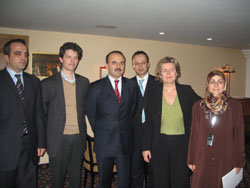 Left to right:Dr. Mehmet Yildirim,the head of the Istanbul Health Department,Dagur B. Eggertsson, Youth in Europe project key figure ,Dr.Muammer Erol, Vice-Secretary General of Istanbul Municipality,
Dr. Mustafa Güveli,the coordinator of the project on the side of Istanbul,Mrs. Kristin Arnadottir, key figure for the Youth in Europe programme, and Dr. Nalan Engin, the contact person for Youth in Europe in Istanbul.
Left to right:Dr. Mehmet Yildirim,the head of the Istanbul Health Department,Dagur B. Eggertsson, Youth in Europe project key figure ,Dr.Muammer Erol, Vice-Secretary General of Istanbul Municipality,
Dr. Mustafa Güveli,the coordinator of the project on the side of Istanbul,Mrs. Kristin Arnadottir, key figure for the Youth in Europe programme, and Dr. Nalan Engin, the contact person for Youth in Europe in Istanbul. |
|
|
The cities of Istanbul, Helsinki and Stockholm joined the pan-European ECAD project Youth in Europe – a drug prevention programme.
Deputy Mayors of Stockholm and Helsinki, Mrs. Margareta Olofsson and Mrs. Paula Kokkonen, and Vice-Secretary General of Istanbul Metropolitan Municipality, Dr. Muammer Erol
signed the agreement at ECAD Advisory Board meeting in Istanbul.
Ten cities have already signed and more are expected to join in the coming weeks and months.
Actavis Group is the main sponsor of the programme, which includes a special contribution for research and social action in Istanbul as well as in the cities of St. Petersburg, Vilnius, Belgrade and Sofia.
The cities will carry out three surveys among 15-16 year olds on lifestyle, aspirations and drug use in the next five years and also work towards mobilising society against drugs according to the programme outline.
|
23 January 2006
Three more cities, Vilnius, Kaunas and Klaipeda in Lithuania signed Letter of Intent to join
ECAD`s new project "Youth in Europe".
|
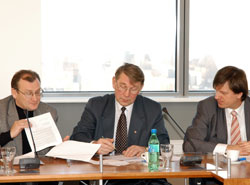 Left to right: Algimantas Shventickas, Director of Department of Culture, Education and sports, Vilnius Municipality, Kazimieras Kuzminskas, Kaunas Vice-Mayor and Dr. Saulius Chaplinskas, Director of Lithuanian AIDS Centre
|
 Tomas Hallberg and his Lithuanian colleagues
Algimantas Shventickas, Kazimieras Kuzminskas and Saulius Chaplinskas are ready to start working on the project
Photo © Audrius Žygavičius |
|
|
The municipalities of Vilnius, Kaunas and Klaipeda alongside with Lithuanian AIDS Centre and ECAD are to cooperate together in the International Drug Prevention Programme. Appropriate cooperation agreements were signed January 23, 2006.
"15 European cities are joining the project for the time being", says ECAD Director Tomas Hallberg.
"The project is aimed at influencing both mentality-change (by raising awareness of drug, marihuana and tobacco use related risks) and behaviour change among the young.
This knowledge- and experience-based project is to be implemented through combined efforts of different cities", says Dr. Saulius Chaplinskas, member of ECAD Board and the Director of Lithuanian AIDS Centre. (www.aids.lt)
"After the similar project was started in Iceland, drug use among 15-16 year-old youth decreased by 15%", says Dr. Chaplinskas.
International Organisation European Cities Against Drugs unifies more than 250 cities in Europe in their efforts to decrease drug use and drug related negative effects on society.
|
19-20 December 2005
WHO report on needle exchange likely to be revised

Geneve expert panel |
|
During an expert meeting organised by Institute of Medicine in Geneva on December 19-20, 2005, Alex Wodak, the author of the WHO report on the effect of needle exchange on HIV among intravenous drug addicts,admitted that mistakes might have been made, and that he would go over the report again.
|
- There were many reports to read, over 200 of them, there may be errors, and if that is the case, I will come back with corrections, said Wodak.
This took place after the Swedish scientist Kerstin Käll, herself co-author of a study on the same subject, passed devastating criticism on Wodak`s report.
In her address, Käll dealt with some of the conclusions Wodak made of the materials he and his co-author gathered, and pointed out the incongruities of the same.
- There errors are easy to find for anybody, who reads the report, said Käll.
For example, Wodak had included in his report a study as evidence of needle exchange programs` effectiveness on HIV prevention, which did not measure this factor, but only HIV prevalence in the returned syringes.
From Kerstin Källs speech:
”I see the following problems with the Australian studies:
Since the stage of the epidemic is not stated for the different cities you will not know if you are measuring during the rapid phase of increase or on the downward slope or if there was an epidemic in the city at all. It is not unreasonable to suspect that most countries react slowly and introduce NEP (Needle Exchange Programmes) after the rapid phase, which would tend to bias data in favour of NEP. Cities not hit at all by the epidemic may not be included in the study unless they have a NEP, which would bias in the same direction.
In cities hard hit by the epidemic it is likely that frequent measurements will be done during the initial rapid phase because of the alarm raised by the outbreak, which would bias against cities without NEP. It is also noteworthy that as many as 48% of the cities with NEP studied by Hurley and co-workers had an increase of HIV seroprevalence in spite of NEP.
With these serious limitations it seems to me that it is not possible to draw any conclusion about the effectiveness of NEP from these two studies”.
Wodak had also included the needle exchange programme in the Swedish city of Lund. Lund has never experienced an HIV epidemic in the first place, and the Swedish experts agree on that there is no scientific evidence of the programme’s HIV-preventive effect.
Käll criticised Wodak further for the incorrect methods he used when comparing HIV prevalence in various cities around the world.
For example, cities were compared at different time periods. There are great risks involved if results of needle exchange programmes are compared without controlling whether the interventions were effectuated during different stages of the epidemic.
From Kerstin Källs speech:
In review by Dr. Wodak and his co-workers looking at NEP:s effect on HIV prevalence and incidence they end up with a case of 6 to 5 in favour of NEP (6 positive, 5 inconclusive or negative).
First: The study by Monterosso and co-workers is misclassified as positive for NEP, whereas in fact the result is non-significant, which is correctly stated in the table.
Number two: the study by Heimer and co-workers also listed as positive does not measure HIV prevalence among IDUs (Injecting Drug Users), but HIV prevalence only in returned needles, which cannot be directly translated into population. This study should not have been included at all.
And finally, the study by Ljungberg and co-workers is used to compare the HIV prevalence in the south of Sweden, which was not hard hit by the epidemic and had NEP introduced 1987/1988, with Stockholm that had a rapid phase 1983 to 1985 with a prevalence of about 50% of heroin injectors. Wodak and his co-workers ignore that the authors point out that in Stockholm by the time of the study the incidence was already down to about 1%. If this study should be included it should be moved to the inconclusive.
With these corrections the case of NEP is reversed to 3-7, thus no longer in favour of NEP.
The scientific data do not support the idea that NEPs in and by themselves are effective in preventive the spread of HIV among IDUs. By putting so much faith and emphasis on this isolated measure, other important and well established tools, like HIV testing and counselling, contact tracing etc. may have been neglected in the strategy to combat the spread of HIV among IDUs in many places.
I think this is particularly unfortunate for the countries that have the biggest problems today, where limited resources must be used where they are most effective. If you have to choose between NEP and HIV testing and counselling, it is crucial that you choose the most effective strategy."
Alex Wodak was during many years leader of the international harm reduction movement. He launched both needle exchange programmes and injecting rooms in Australia on his own initiative, before these became legal in the country. Wodak has also taken active part for legalising cannabis.
The complete version of Kerstin Källs speech is available at ECAD Office:
Phone: +46 8 508 29 362
e-mail: ecad@ecad.net
You may find Alex Wodak`s report "Effectiveness of Sterile Needle and Syringe Programming in Reducing HIV/AIDS among Injecting Drug Users" (Geneve, 2004)(pdf-format) here!
|
14th of December 2005
St.Petersburg - first to sign Letter of Intent to join "Youth in Europe"

Standing from left to right: Kristin Arnadottir, Dagur Eggertsson,
Robert Wessman, Olafur Ragnar Grimsson, Tikhonov Valery V., Prokhorenko Alexander V., Sherstniov Sergej Y., Kramarev Arkady G.
Sitting: Tomas Hallberg and Valentina Matvienko. |
|
After some continuous preparatory work the agreement to take part in Youth in Europe, Drug Prevention Programme was signed on the 14th of December, 2005 by the first city outside Iceland.
The president of Iceland Olafur Ragnar Grimsson was present at the signing ceremony in St. Petersburg, Russia.
A lot of profound work has been done on the part of St. Petersburg’s state lawyers and one of the project’s key figures – Kristin Arnadottir. Thanks to their efforts, the governor of St. Petersburg city, Valentina Matvienko and ECAD director Tomas Hallberg could put their signatures on the document that became the starting shot for the launch of many practical tasks to be performed by the participating cities.
|
The president of Iceland, who is also the patron of the project, stressed the importance of St. Petersburg becoming the first city to sign the Letter of Intent. There is a great symbolic meaning in St. Petersburg being the first to enter this international cooperation, since this city was one of ECAD`s prime members and among most active ones.
During the visit to St. Petersburg His Excellency Mr. Grimsson read a lecture about Icelandic drug preventive experience at St. Petersburg State University, that was very much appreciated by the students.
St. Petersburg is one of the five cities that the project sponsor, Actavis Group, supports financially to make their participation in the Drug Prevention programme easier.
|
[Articles July 2005- May 2002]
|