| |
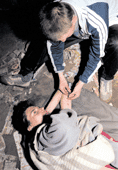 |
Drug addicts in S:t Petersburg.
ECAD Regional office started November
2001. Please have a look at their website
www.ecad.ru!
|
What's going on in ECAD: ARCHIVE July 2005 - May 2002
20-24 July 2005
Swedish top rider gives a promising example in San Patrignano
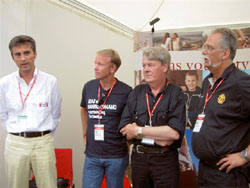
From left to right: Giacomo Muccioli, Jumping Organising Committee President,
Tomas Hallberg, ECAD, Åke Setréus, ECAD, Christer Karlsson, KRIS
|
|
FEI European Jumping Championship (EJC) held on 20-24 July was organised by San Patrignano, which is one of the biggest international rehabilitation centres for drug addicts, might become a trend-setter for significant sport events in the future. For the first time a sports competition of such scale and dignity was arranged by former drug addicts.
It was also for the first time that former drug addicts had an opportunity to convey a drug policy message. ECAD was present there to promote its name as a partner and to contribute with its knowledge about European anti-drug policy.
|
ECAD contacted Swedish top female rider, Malin Baryard, before the event to ask her to lend her name for the Championship. The Italian organisers did not make a secret of the fact that she was among the most wanted guests there. A young female horse rider with a fantastic beaming smile, who has recently become a mother – who could be more attractive?
“ I gladly accept this offer”, - announced Malin Baryard. “All children have the right to grow up in the drug-free atmosphere. I was lucky enough not to see drugs in my childhood. Drugs were hardly even mentioned at that time.
I have nothing against becoming a role model. I am already one, no matter if I want it or not. So in this case it is better to be a good model.”
We, people who work against drugs, might be too careful when asking a role model if he/she wants to participate in the event of this grade. There are so many strong personalities who would love to get into this position if we simply asked...
A representative of the International Championship organisers in Germany next year listened very attentively about the cooperation between ECAD and San Patrignano centre before the EJC. He was interested in the possibility to link sports with a message to society.
Social sponsoring could probably be one of the ways to attract more cities to get involved in the organisation of various big events. Working in positive environment to change the common view on drugs in society can bring some lucrative results in the long term for the organising cities.
So how did the Championship end? The Centre had its own horse in the competition, but it did not get any of the prizes. However, the audience marked a special victory of the equipage with extensive ovations for just taking part in the competition. Butterfly Flip, the horse of Malin Baryard got infected during the competition and refused to join in.
Heavy rain showers went on for several hours during two days or the Championship, but the event was still very much appreciated by the participants, the public and the press.
ECAD had a chance to show itself acting in a different environment. Common interest to our exhibition was remarkable and we should be satisfied with all the attention we were given by the massmedia all over Europe.
(Even a Japanese newspaper wrote an article about Malin Baryard, ECAD and San Patrignano).
Some facts about San Patrignano:
- Collective treatment Centre for drug addicts, most of them heroin-addicts.
- About 1800 persons live in three places near the city of Rimini in Italy.
- Around 70 % are still drug-free after 2 years of treatment “graduation”.
- San Patrignano does not accept money from the state and it is impossible to get a place in the centre for a payment.
- 60% of all expenses are covered by their production and the rest comes from private donations.
|
4 May 2005, Press Release
Malin Baryard – San Patrignano 2005’s New Spokesperson
 Malin Baryard and Tomas Hallberg, Director ECAD
Photo © Maria Söderberg |
|
Malin Baryard, Sweden’s top female rider, will be lending her name and image in order to help promote this year’s FEI European Jumping Championship, scheduled to be held at San Patrignano (Rimini, Italy) next July 21st through 24th. She was enthusiastic at the idea from the start, in view of the partnership between Europe’s largest drug rehabilitation community and ECAD (European Cities Against Drugs), an organization which gathers more than 250 member cities (22 of which capitals) in 30 European nations.
Giacomo Muccioli, president of the event’s organizational committee, expressed his pleasure upon hearing of the collaboration, “This Championship is truly a unique opportunity. For the first time, the event will be completely organized by the young men and women of a drug rehabilitation community. They are living proof that it is possible to overcome addiction. And the presence of someone as important as Malin Baryard is extremely important in order that we may further spread our strong message against drugs throughout Europe.”
|
Malin is thirty years old and the proud mother of a two-month old baby boy named Alvar. In her home country of Sweden she is a celebrity, hosting a weekly show about horses on the nation’s largest network. In addition, she is often asked to pose as a model for her sponsor, H&M, a well-known clothing chain based in Northern Europe. She is already the winner of two important medals: team silver from the 2000 World Championships at Jerez and an Olympic team bronze from the Athens games.
Malin, who is one of show jumping’s most well-known faces, wholeheartedly supports the social and cultural message behind this year’s Championship. With the full force of her convictions, she stands behind the strong anti-drug message sent by the event throughout the world. “I think it’s great that the Championship is being held at San Patrignano- for us athletes, for the public, and for the young people of the community. This way, they have a chance to be involved in an important event and to show what they are capable of.”
Malin has always expressed an interest in social problems-especially when speaking about young people, and the volunteer organization which deal with their problems. She is wholly conscious of her role as a model for young people, being a star athlete. Malin is aware that all athletes must give an example in their behavior on and off the field. “To be an athlete at a higher level, you are a role model. It’s nothing you chose, it’s nothing you can take away, you are a role model, and you should be happy to be it. The point of life is surely not to win competitions, but I love winning. I am a role model as a person riding horses and being active and treating my horses well and all this, but I think an athlete is a role model, anytime. You just have to be sure you do a good job. “
This is why Malin agreed to pose for a photo shoot and conduct an interview on her farm in Norrkoping, where she is preparing for the European Championship, in order to help promote one of the projects which San Patrignano is undertaking in view of next summer’s competition: the collaboration between San Patrignano and ECAD. The project aims to spread a message of solidarity throughout Europe, and, through the realization of the Championship by the young people of San Patrignano, to show that it is possible to overcome addiction.
Malin does not hesitate to express her fears in regards to this very serious social problem. “I think it’s very scary when you hear how much drugs there is. Especially how much younger it goes. You have the possibility of getting drugs from anywhere now. It’s really something that needs to be worked on, to get rid of.”
So it seems that Sweden’s top rider is more than happy if an event such as this one can be helpful on a social level. All of this without forgetting (as she says) that horses and sport, equitation have given meaning to her life. In other words, the perfect antidote to social marginalization.
The interview and photo session with Malin Baryard are available on www.sanpatrignano2005.org
San Patrignano Press Office
Tel +0541 362111
e-mail pressoffice@sanpatrignano.org
Click here to read more about this event!
|
10 April 2005, London, UK
San Patrignano 2005: equestrian sport and solidarity a winning combination
|
|
Press release
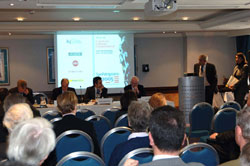
The 2005 European Jumping Championship which will be held in the equestrian facilities of the San Patrignano community (Rimini - Italy), from 21 to 24 July were presented this morning in conjunction with the FEI General Assembly taking place in London.
San Patrignano is the largest rehabilitation centre from drug addiction in Europe and in 26 years of its activity have welcomed and reinserted in the society in a drug free condition over 20.000 people.
Giacomo Muccioli, President of the Organising Committee of the event and Cesare Croce,
|
President of the Italian National Equestrian Federation highlighted the important support and patronages obtained by next July’s Championships such as the one of the United Nations Office on Drugs and Crime (UNODC); the Regional United Nations Information Centre (RUNIC); the United Nations International Year of Sport and Physical Education; and of the European Cities Against Drugs (ECAD).
The strong involvement in the project of the FEI was underlined by the significant presence of the 1st Vice President Freddy Serpieri, who in his address focussed on the unique opportunity that the world equestrian community is given by this Championship to contribute to spread the social message of San Patrignano.
The Chairman of ECAD, Jim Corr, explained the importance of this event which will be the first ever top sport event to be entirely organised and hosted by a community for the rehabilitation of drug addicts. “When ECAD speaks of drug free Europe there are many who call it a utopia. If I had told you fifteen years ago that the Championships will be organised by former drug addicts in a treatment centre you would all have called it a utopia”.
The importance of the horses within San Patrignano was stressed even more with the announce of the strong cooperation with UNIRE (National Union for the Increment of Horse Breeds) which has chosen to fully support the Championships’ project that is strongly orientated not only to the sport but also to the promotion of horse breeding in Italy. San Patrignano also represents one of the largest and most recognised studs in the country.
During the conference it was also presented the ad starred by the top riders Ludger Beerbaum, Markus Fuchs, Ludo Philippaerts and Jerry Smit to promote the social meaning of the event. The ad is the result of another important partnership between the community and the International Jumping Riders Club.
San Patrignano 2005 Press Office
Click here to read more about this event!
|
1-2 March 2005, Brussels
International Dimensions for European Drug Policy
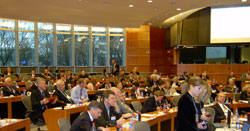 Conference at the European Parliament
 |
|
This ground-breaking event was held at the European Parliament in Brussels, Belgium for approximately 130 delegates from throughout the European community. The conference “International Dimensions for European Drug Policy” was organised by European Cities Against Drugs, Institute on Global Drug Policy, International Scientific and Medical Forum on Drug Abuse and supported by Drug Free America Foundation, Drug Prevention Network of the Americas. The conference was hosted by Mrs. Charlotte Cederschiold, MEP from Sweden, Former Vice President of the European Parliament.
|
Experienced and forward-thinking policy experts explored the global impact of harm reduction on drug policy. The agenda covered current topics such as needle exchange programs, harm reduction from a political standpoint, the Swiss/German experience with heroin programs and the US drug-related prison population, to name a few.
Keynote speakers included Herbert Schaepe, former Secretary General of the International Narcotics Control Board (INCB), Morgan Johansson, Minister of Public Health, Sweden, John Walters, Director of the US Office of National Drug control Policy and other high-level international drug policy experts.
Read the addresses and handouts here! (“Conference papers”)
|
4 March 2005, Stockholm
Co-operation agreement between ECAD and Veliky Novgorod
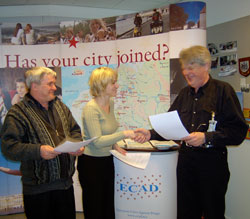 Anatoly Fadeev, Olga Vasileva, Åke Setréus
 |
|
|
|
Representatives for ECAD, Ass director Åke Setréus, ECAD office in Veliky Novgorod (Russia), Olga Vasileva and V. Novgorod's non-governmental organisation "Grani" signing co-operation agreement.
ECAD office in V. Novgorod facilitates co-operation between the municipality, authorities and non-governmental organisations in the field of drug prevention and rehabilitation.
V. Novgorod is an active member of ECAD.
|
3-5 February 2005, San Patrignano, Italy
ECAD Advisory Board meeting
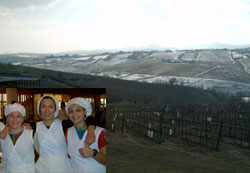 Winter in San Patrignano...
 |
|
The ECAD Advisory Board held its spring meeting on 3-5 February in San Patrignano, Italy.
San Patrignano, home to 1.800 former drug addicts, is the largest European community for the rehabilitation of drug addicts and is completely drug free.
Among the items on the agenda was ECAD’s budget for 2005, which was agreed by the Board.
A proposal from Reykjavik for a drug prevention program for youth in Europe was discussed in depth.
|
The outline of the project is that a selection of ECAD member cities shall conduct a four year program among young people aged 15-16 to reduce the use of tobacco, alcohol and drugs. The program will be evidence based with a strong element of international comparison, and shall be scientifically evaluated. The final proposal will be presented at the Plenary session at the ECAD Mayors’ conference in Oslo on May 27th.
Furthermore the Advisory Board accepted the offer for ECAD to appear as co-promoter for the FEI European Jumping Championship, an international horse show in San Patrignano on 21-24 July. Under the heading ”European Cities and San Patrignano: Overcoming Obstacles”,
ECAD’s and San Patrignano’s message against the use of any and all drugs throughout Europe will meet the expected 5000 spectators as well as the media coverage of the event.
Detailed information about the FEI European Jumping Championship see here!
|
31 January 2005
Oslo opens drug injection rooms

|
|
After a long process, the City of Oslo has opened the first municipal drug injection room in Scandinavia. January 31st is a watershed in Norwegian drug policy, marking an obvious breach against UN Conventions on drugs. United Nations’ drug control organ INCB has time after time called attention to the fact that introduction of injection rooms for drug addicts plays in the hands of the international drug traffickers. The international drug conventions came about many decades ago specifically in order to eliminate places like opium dens, where drugs could be abused without penalty.
|
Debates about drug injection rooms have been going on for more than five years in Norway. Every possible argument for and against has been aired, and those advocating for injection rooms won the last round.
All countries which have signed the UN Drug Convention of 1988 thereby agreed to introduce prohibition against possession of drugs in their penal codes. By opening drug injection rooms, a government can be held responsible for breaking an international agreement by facilitating the crimes of possession and consumption of drugs as well as of drug trafficking.
Oslo has been a very active member of ECAD since the very beginning. ECAD was founded as a reaction against, above all, Dutch and German cities’ policies for legalising drugs and introducing injection rooms. It is therefore surprising, to say the least, that Oslo now chooses the opposite standpoint.
In historical perspective we have seen governmental and municipal programs which contain similar modes of reasoning to those of Oslo’s. USA’s first maintenance program, opium to opium addicts, started in the Philippines in 1903. The first drug clinics in USA were opened in 1912, and operated for 13 years before the last of them was closed. These completely failed experiments returned first 25 years later, and then the substance was called methadone.
History has shown us that administration of drug abuse instead of combating it does not work in the long run.
A Norwegian evaluation (NAD publication 41) shows that Norway has 3-4 times more heroin addicts per inhabitant than Sweden. This might call for establishing a Norwegian expert commission to compare the effects of drug policies between these two neighbouring countries.
The Norwegian experiment is conducted by support of a new law which remains in force for 3 years.
|
December 2004
Norwegian Cities Against Drugs –
the Norwegian network of ECAD member cities
 Bergen, photo visitbergen.com
 |
|
In December 2004 Norwegian members of ECAD met for a day seminar, where questions of municipality based prevention programs have been discussed.
The Norwegian network consists of the seven largest Norwegian municipalities with the city of Bergen leading the network for 2005.
|
The participants agreed that, in the light of the recent studies in the drug field, an increased focus on early drug prevention and better living standards for active drug users should make the basis for comprehensive approach to the drug problem on a local level. For a municipality this means prioritising measures to counteract recruitment of young people to the use of illicit drugs, on the one hand. On the other hand, in co-operation with voluntary organisations, to increase the number and quality of drug users-oriented services in such areas as health care, living, employment, daily activities.
Larger municipalities are posed with a special challenge. Competence development and co-operation between all parties is of dire importance. The larger the municipality is, the more efficient co-operation between different departments within the municipality is essential. Specialised services such as psychiatry need to be efficiently co-operating.
All of this constitutes the main directions of activities for the members of the ECAD network in Norway.
Besides that, the network’s task is to develop a common approach to central authorities. The state, say the participants in a declaration adopted at the seminar, has a lesser focus on long-term measures. Municipalities would like to draw attention of the central authorities to long term prevention. This can lead to a more offensive approach on local level, where the every day work with prevention and after care actually takes place.
Latest data shows that the drug problem costs the Norwegian society about 2 billion Euros per year. Effective municipal measures leading to rehabilitation and improved standards of living for drug users will make for a better society for every one.
|
November 8, 2004
European Union Action Plan on Drugs 2005 - 2008

|
|
The Commission has launched a communication on the EU action plan on drugs 2005 - 2008. The action plan will be based on the EU Drug Strategy 2005 - 2012, which is currently under discussion in the EU Council of ministers. The strategy will provide a political framework on drug related action and set the aims and priorities for EU drug policies. The purpose of the Action Plan is to turn the Strategy into concrete, measurable actions for achieving these aims
Below please find
ECAD views on priorities and actions to be amended and/or included in the EU Action Plan on Drugs 2005 – 2008
1. In Cordrogue 53 it is stated (p.1), “ It [the new drugs strategy] aims to protect and improve the well-being of society and of the individual, to offer a high level of security for the general public and to take a balanced, integrated approach to the drugs problem.”
a. Whilst referring to the UN General Assembly Special Session on Drugs (UNGASS) 1998 (p.2), stating that UNGASS “confirmed the
|
importance of the integrated and balanced approach, in which supply reduction and demand reduction are mutually reinforcing elements in drugs policy”, we find it strange that only paragraph 2 of the UNGASS Political Declaration is quoted, where the States Members of the United Nations “recognize that action against the world drug problem is a common and shared responsibility requiring an integrated and balanced approach…” (UNGASS Political Declaration paragraph 2), and at the same time an extremely important paragraph of the same document is omitted.
b. Paragraph 19 of the UNGASS Political Declaration states that [We the States Members of the United Nations] “Welcome the global approach by the United Nations International Drug Control Programme to the elimination of illicit crops and commit ourselves to working closely with the Programme to develop strategies with a view to eliminating or reducing significantly the illicit cultivation of the coca bush, the cannabis plant and the opium poppy by the year 2008. We affirm our determination to mobilize international support for our efforts to achieve these goals.” The future drugs strategy should refer to this commitment unanimously agreed upon at UNGASS in 1998.
2. In Cordrogue 53 it is stated (p.2) that “The Strategy bears in mind the relevant international conventions. The UN Single Convention on Narcotic Drugs (1961), the Convention on Psychotropic Substances (1971) and the Convention against the Illicit Traffic in Narcotic Drugs and Psychotropic Substances (1988) are major legal instruments for controlling the availability of narcotic drugs.”
a. This is true, however the drugs strategy should also contain reference to Article 33 of the 1989 Convention on the Rights of the Child, which puts specific stress on the importance to protect children from the use of illicit drugs and psychotropic substances. Article 33 of the Conventions on the Rights of the Child reads, “States Parties shall take all appropriate measures, including legislative, administrative, social and educational measures, to protect children from the illicit use of narcotic drugs and psychotropic substances as defined in the relevant international treaties, and to prevent the use of children in the illicit production and trafficking of such substances.”
3. ECAD notes that “The Strategy is also intended to allow scope for local, regional, national and transnational dynamics and potentialities. Account is also taken of the organisational and financial constraints of Member States and EU institutions.”
a. This clearly indicates that there will not necessarily be a common EU drugs policy, leaving it up to Member States to engage in “local, regional, national and transnational dynamics and potentialities.” The use of the wording ‘transnational dynamics and potentialities’ should be omitted and substituted for by something more specific as ‘transnational dynamics and potentialities’ could mean anything appealing in the eye of the beholder.
4. The Council has identified two general aims with regard to drugs (pp. 2-3) – 1.To contribute “to the attainment of a high level of health protection, well-being and social cohesion by complementing the Member States’ action in reducing drug-related health damage, including information and prevention”, and 2. “To ensure a high level of security for the general public by taking action against large-scale production, cross-border trafficking in drugs and diversion of precursors, and by intensifying preventive action against drug-related crime, through effective cooperation embedded in a joint approach.”
a. The two general aims mentioned above lack two important items that should be added. 1. To contribute to the attainment of a high level of health protection, well- being and social cohesion, the Drugs Strategy should make it clear that the EU also aims at fighting personal use of drugs as part of efforts to achieve the above objectives. 2. Furthermore, to ensure a high level of security for the general public there is not only need for action against large-scale drugs production, cross-border trafficking in drugs and diversion of precursors and preventive action against drug-related crime, but also need for effective cooperation in a joint approach to fight small-scale production and dealing of drugs on street level.
5. ECAD notes with satisfaction that a balanced approach to the drugs problem requires adequate consultation of the relevant NGOs. Being Europe’s largest organisation in favour of a drug free society rather than a free drug society, ECAD is looking forward to being intensely involved in drawing up action plans for consideration by the Council for the 2005-2007 and 2009-2011 periods.
6. ECAD notes with satisfaction that actions at EU level must state intended results in advance and that actions must offer clear added value and that their results must be measurable and realistic.
7. Even if the Strategy also is intended to allow scope for local, regional and national actions, ECAD notes with satisfaction the demand to improve the present poor coordination on issues where coordination, without creating new institutions, is of great importance, e.g. international cooperation.
8. As pointed out in Cordrogue 53 (p.6), prevention is to be preferred to treatment, treatment is to be preferred to harm reduction and harm reduction is to be preferred to doing nothing.
a. ECAD notes with worry, an increasing tendency in some Member States to medicalize the drug problem through mass distribution of syringes, methadone and buprenorphine and, even worse, of heroin. Even if account must be taken of the organisational and financial constraints of Member States and EU institutions, it is of utmost importance not only to improve a high level of health protection but also to improve access to good quality schools, a functioning labour market and adequate housing facilities. Young people without education and/or a job combined with poor prospects for the future are definitely running a greater risk of being involved in drugs. It should be kept in mind that societal problems usually result in increasing drug problems in the same way as drug problems usually result in societal problems.
b. To avoid confusion, it should be made clear that harm reduction is not the same as prevention. Harm reduction is what you resort to when preventive efforts have failed.
9. In §4 Policy field: supply reduction too much emphasis is put on forms for co-operation rather than the contents.
a. The Action Plans targeting supply reduction must be very specific to make it possible to measure whether intended results have been cost-effective and achieved within the stated timeframe.
10. Cross-cutting theme: international cooperation
a. As mentioned earlier, the contents of paragraph 19 of the UNGASS Political Declaration and the contents of the 1989 UN Convention of the Rights of the Child, especially article 33 should be included and stressed in the Drugs Strategy if the global nature of the drugs problem is to be taken seriously and if the EU aims to expand its political influence on drug related issues internationally.
11. Cross-cutting theme: information and evaluation
a. Information should advocate non-use of illicit drugs. Courses and/or information on alleged ‘safe use’ is snake oil prevention and should be omitted completely as there is no such thing as ‘safe use’ of illicit drugs. Testing of MDMA pills at raves, acceptance of use of smaller amounts of drugs, injection rooms, and mass distribution of syringes to mention a few examples could condone drug use and should therefore be reconsidered as good examples of an integrated and balanced approach to the drug problem.
12. Facing drug production and drug promotion problems within the European Union
a. Nowhere has there been any specific mentioning of the importance of fighting drug production within the European Union. The EU Drugs Strategy 2005-2012 provides a historic possibility to start work to close down coffee shops in the Netherlands, to initiate efforts to terminate ecstasy production in the same country as well as drug production in Belgium and Poland to mention a few examples. Recent, successful efforts to destroy sale of cannabis products, totalling an estimated 500 million Danish crowns per annum in Christiania in Copenhagen, could serve as an example for similar efforts in other countries faced with open markets for sale of drugs.
Click here to read the "ECAD views" in PDF-format, easy to print out!
|
14-15 October 2004
ECAD network in Sweden
Conference in Uppsala
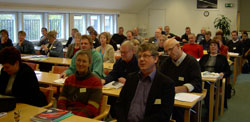 Participants of the ECAD Sweden Conference
 |
|
|
The Fourth conference for the Swedish members of ECAD took place in Uppsala in October. 65 delegates from 20 cities participated in the event. The focus for this year discussion was the anti-drug fieldwork carried out by the host city. Uppsala presented a co-operation project between local authorities, police and infectious disease control department. As a result of the joint efforts, there are less “problem” drug users and addicts with HIV/Hepatitis in the city than in the country in average.
Next conference is planned for September 2005 on Gotland.
For more information about Uppsala project please contact ECAD representative in Uppsala Jan Dahlman at
jan.dahlman@uppsala.se
|
September 7, 2004
INCB visiting ECAD
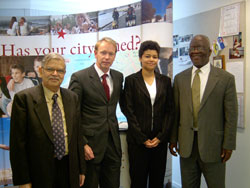
INCB visiting ECAD on September 7th, 2004.
From right: INCB President Philip O. Emafo, Drug control officer Beate Hammond, ECAD Director Tomas Hallberg, INCB member Madan Mohan Bhatnagar |
|
“There is no risk that INCB becomes drug liberal”, declared its President, Philip O. Emafo while visiting ECAD. “Even if one comes to us with a tolerant attitude, one changes it in the process. Our mission is strictly juridical. There is a legislation that should be protected and its wording to follow. Since we make all decisions in consensus, our decision making process implies long and deep discussions before any decision is being made. Therefore it would be difficult to push through an interpretation that would conflict with the spirit and wording of the UN Conventions on drugs”.
|
Every year INCB sends a mission to different countries in order to at the place to form an opinion of how the UN Conventions are being followed. It was 12 years ago Sweden received the INCB mission for the last time and much has changed since then. The National Board of Health and Welfare acted as the host for the visit, which included a meeting with the governmental committee “Mobilisation Against Drugs”, visits to the Stockholm’s treatment centre for young addicts “Maria Ungdom” and to the Police. Visit to ECAD was a wish from the INCB.
“We are glad to meet you and to get to know more about your work”, explained Philip O. Emafo. “Non-governmental organisations’ input in the fight against drugs is of big importance. We appreciate very much that support to the UN Conventions on drugs that your organisation, among the others, showed by collecting 1.3 million signatures before the 46th Session of the UN Commission on Narcotic Drugs in Vienna in 2003. The UN conventions on drugs need all support they can get and we are grateful for the work that ECAD puts into it.
Concerning the issue of injecting rooms, the President of the INCB said that “we are firm in our conviction that injection rooms are in violation of the UN Conventions on Drugs. Despite of the fact that we have repeatedly declared our position, rumours emerge that tell about the contrary. The fact that there is an intention to introduce such facilities in Oslo is alarming. It is probable time to visit Norway, the President concludes.
|
August 23-24,2004
24-hour meeting against drugs in Stockholm
|
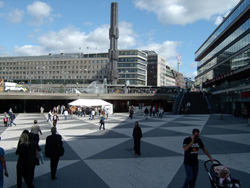 Sergels Torg, Stockholm
|
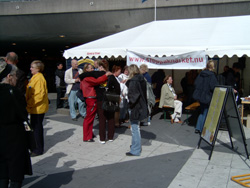 Tent action
|
|
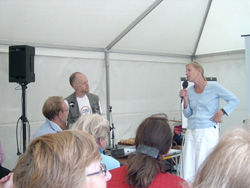 Kristina Axén Olin, Stockholm
|
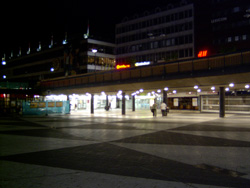 24:00
24:00
|
|
|
Cowardice, political blunder and a lack of engagement hinder any solution of the trafficking in drugs on Sergels Torg. This is the opinion of a number of Swedish public organisations that initiated around-the-clock meeting against drugs on Sergels Torg, in the centre of Stockholm, on August 23-24, 2004.
The idea behind this initiative is to show that there is an immense knowledge and experience about the drug problem in Sweden since more than 40 years back. But useful knowledge is not fully utilised. Politicians and authorities conceal themselves behind rhetoric such as “the issue is under investigation”, “a research needs to be done” or “we must take a look at this”. There is nothing wrong with research or investigations apart from that in practice this rhetoric become a tool for passivity. Meanwhile the drug abusers increase in number and more of them die prematurely.
This meeting shows that everything has already been prepared to start working if one really wanted to make a difference. There is knowledge, legislation, engagement, ideas and experience of what has proved to work. Yet the responsible politicians and the authorities do not seize on this store of knowledge but instead point at each other and excuse themselves. Today's situation on Sergels Torg is a sad example of this failure.
More than 50 speakers came and talked during the meeting. Among them were politicians, teachers, parents, doctors, artists, writers, experts, researches, police. There were about 40-50 listeners for each program point during day-time, not to mention all passers-by who stopped by the tent for a few minutes. About 5-10 people were present during each of the presentations in the middle of the night.
Among the organisers were Parents Against Drugs (FMN), the temperance movement IOGT-NTO Stockholm, Criminals’ Return Into Society (KRIS), Association for a Drug-Free Society (RNS), European Cities Against Drugs (ECAD) and others.
The meeting is to be continued. Ministers for Health and Justice have promised to come and to discuss the drug problem on Sergels Torg with the public September 23, 2004. ”Ministers Against Drugs” – it is not such a bad idea! We shall and will meet again on Sergels Torg!
|
July 2004
The false rumour about INCB and injecting rooms
|
|
|
The rumour now circulating in Germany and elsewhere telling that the INCB (International Narcotic Control Board of the UN) has changed, or is about to change, its opinion on drug consumption rooms (injecting rooms) is completely false!
The INCB stays totally firm in its conviction that drug consumption rooms are “in violation of the international drug conventions” and that they are “in contravention of the international drug control conventions”.
(click here to read letter from INCB)
According to the rumour some representatives of the INCB, during a visit to Germany, should have uttered positive remarks concerning drug consumption rooms. This has been interpreted so that the INCB has changed its opinion. The rumour has also already reached politicians and officials. So have for example officials from the Ministry of the state of North Rhein Westphalen quoted it.
The rumour has gained ground and caused a lot of confusion as well as raised many questions among people active in the drug political field such as:
- Has the INCB changed its opinion on drug consumption rooms or is the INCB planning to do so?
- Has the INCB any intention to modify the UN Conventions regarding this matter?
- Has the INCB taken any actions concerning the existence of injecting rooms in some countries?
- What is the INCB´s opinion on “Harm Reduction”? (Under the umbrella of Harm Reduction often called Risk Reduction, including injection rooms, drug politics in several European countries have changed in a more liberal direction, which by many is seen as a way to circumvent the UN conventions on drugs.)
A rumour or a myth that is not counter-attacked and stopped tends to live its own life, and quoted often enough becomes a “common adopted truth” also among politicians, journalists and media. In order to stop the rumour it is important to find out how it arose and get the real facts out in public.
Some research gave the following result:
- In July 2003 representatives from the INCB visited the German city of Essen with about 600 000 inhabitants. The purpose of the visit was to make an inspection of the drug consumption room to discuss the Board´s concern regarding these facilities and their violation of the international treaties.
- At a conference in April 2004 of the Health Committee of the German Cities Parliament in Bayreuth the deputy mayor of health affairs of Essen was an invited speaker.
In his speech the deputy mayor informed the conference delegates about the visit of INCB to Essen in July 2003. According to him the representatives of INCB had uttered positive remarks during the visit regarding drug consumption rooms and also spoken about a pleasant development. Furthermore the INCB representatives, so the deputy mayor, had talked about a modification of the UN conventions (regarding drug consumption rooms).
What was said at this conference in Bayreuth seems to be the main source of the rumour.
According to the deputy mayor of Essen, drug consumption rooms have “a therapeutical value” and regarding the city of Duesseldorf (which has no injection room and has a different view on drug policy) he spoke about an “eccentric attitude” – not a very positive remark. The “eccentric attitude” probably refers to that Duesseldorf adheres more to the UN conventions on drugs than many other German cities and the German Government.
In order to get a fresh and updated opinion from the INCB as well as answers to the questions mentioned above, I wrote a letter to the INCB.
The answer of the INCB Board is the very clarifying letter attached, which leaves no doubt about the stance of the INCB concerning drug consumption rooms!
Very worthwhile reading is also the Annual Report 2003 of INCB, for example:
* Paragraphs 559-561 where the visit to Essen is described
* Paragraphs 223-224 leave no doubts of the opinion of INCB concerning drug injecting rooms.
* Paragraphs 217-226 where the INCB makes a clarification of its critical view on “Harm Reduction”. In § 220 can for instance be read: “The Board regretted that discussion on some “harm reduction” measures had diverted the attention (and in some cases, funds) of Governments from important demand reduction activities such as primary prevention or abstinence-oriented treatment”.
EU-governments pushing politically for injecting rooms
The false rumour about INCB having changed its opinion on drug consumption rooms has to be seen and put in a broader political context. For some years politicians and governments that have allowed the establishment of such facilities (although knowing that they are violating the conventions they have signed) have pushed for and tried to persuade the EU, the Council of Ministers, the European Parliament and other member states to also adopt the idea of consumption rooms.
So did for example the German and some other governments fight very hard and determined in 2002 for this in the negotiations concerning the “Council Recommendation on the prevention and reduction of risks associated with drug dependence” (COM (2002) 201 final).
The Recommendation was an initiative of the EU Commission and Commissioner Byrne. It was the first time that article 152, the public health article, was applied and tested in drug related issues.
With Germany in the lead some countries tried intensively to get the acknowledgement of drug consumption rooms into the text of the Recommendation and adopted as a by EU recommended risk reduction measure. After months of discussions it was clear that they would not succeed since the majority was against it. If adopted, it would have meant that all (at that time 15 now 25) member states would have adopted a policy opposing the INCB and violating the conventions! This would of course severely have undermined the UN Conventions and the INCB.
Knowing that the German government and some others are pushing for injecting rooms the question arises: Is the false rumour about INCB due to a simple misunderstanding or not? The future will tell.
Ms MaLou Lindholm
Former Member of the European Parliament
Member of Drug Watch International
Deputy Director HNN International Centre
|
June 2004
Submission to the European Union’s future drugs policy
|
|
|
With 250 signatory municipalities in 27 countries to the ECAD (European Cities Against Drugs) Stockholm Resolution, ECAD is Europe 's leading organisation promoting a drug free Europe. ECAD represents millions of European citizens who are very concerned about the fact that drug trafficking, drug dealing and drug abuse cause enormous problems in Europe.
Nations and their citizens are affected by the consequences of the drug trade, which today poses serious threats to any democratic society due to the enormous amount of money involved in the drug business and, consequently, serious risks for corruption, narco-terrorism and organised crime, including money laundering.
ECAD member cities work to develop initiatives and efforts against drug abuse supporting the United Nations Conventions Against Drugs, which oppose legalisation and promote policies to eradicate drug abuse world-wide.
Too often we take it for granted that every citizen in our societies - politicians, members of various authorities, including law enforcement agencies - want to prevent use of drugs. However, this is no longer necessarily true. A growing movement in some European countries is now discussing how to reduce drug-related harm or how to manage the risks involved with the use of drugs and some even propose decriminalisation and/or legalisation of certain drugs.
A movement with such an agenda is part of the drug problem rather than part of a solution to the drug problem.
ECAD believes in and works for a drug-free Europe. Use of cannabis, amphetamines, heroin, cocaine and other narcotic drugs is not a basic part of our culture and the use of such substances must be fought with decisive and comprehensive measures.
A number of cities and countries have been successful in their combat against drugs by combining restrictive policies with a wide range of preventive measures and by offering drug abusers various forms of care and treatment. It is indeed possible to introduce changes to reduce the spread of drugs. In doing so, it is most important to actively encourage young people to reject all drugs.
ECAD does not believe in making a distinction between so-called 'hard' and 'soft' drugs. All drugs are dangerous. Consequently, the use of cannabis should be opposed with much the same vigour as other drugs.
ECAD supports the existing UN Conventions on Drugs, the Political Declaration and the Guiding Principles of Demand Reduction approved at the UN General Assembly Special Session on Drugs in New York in June 1998, as well as the UN Convention on the Rights of the Child, and urge intensified national and international co-operation to fight drugs. The United Nations should be given power to control flagrant breaches of conventions and international agreements wherever they emerge. If some countries allow drugs to be made freely available, they undermine the possibilities of other countries and cities to curb the spread of drugs.
European Cities Against Drugs are
In favour of real freedom from drugs, not the manipulative 'freedom' experienced through drugs
In favour of societal actions to decrease unemployment, racism and social injustice
In favour of abstinence-oriented measures to wean drug users off drugs
In favour of developing care and treatment for drug users
In favour of pro-active and assertive prevention measures
In favour of international co-operation
Against legalisation of illicit drugs
The present development in some European Union Member States is a cause for concern as distribution of heroin, injection rooms, massive and badly controlled distribution of methadone and buprenorphine, to mention but a few 'initiatives', are labelled 'harm reduction ' measures whereas, as a matter of fact, they should rather be labelled 'harm production' measures.
In several of the annual reports from the Vienna-based UN agency INCB (International Narcotics Control Board), the Board has expressed great concern about such measures. In its latest Annual Report, issued March 3 2004, INCB cautions on so-called 'harm reduction' measures in drug control and "calls on Governments which intend to include 'harm reduction' measures into their demand reduction strategy, to carefully analyse the overall impact of such measures. These may sometimes be positive for an individual or for a local community while having far-reaching negative consequences at the national and international levels."
The Vienna-based INCB which monitors the implementation of international drug control treaties has already, in previous Annual Reports, clarified its views on a range of 'harm reduction' measures - actions which are taken with the intention of reducing the negative consequences of drug abuse. In its Report for 1993, the Board already "acknowledged the importance of certain aspects of harm reduction as a tertiary prevention strategy for demand reduction programmes." In its Report for 2000, "the Board reiterated that harm reduction programmes could play a part in a comprehensive drug demand reduction strategy. The Board drew attention to the fact that harm reduction programmes could not be considered substitutes for demand reduction programmes."
In the 2004 Report, the Board reiterates specific statements and recommendations concerning the following "harm reduction" related measures:
Needle/syringe exchange or distribution programmes
"Governments need to adopt measures that may decrease the sharing of hypodermic needles among injecting drug abusers in order to limit the spread of HIV/AIDS. At the same time, the Board has been stressing that any prophylactic measures should not promote and/or facilitate drug abuse."
Substitution and maintenance treatment
The implementation of substitution and maintenance treatments "does not constitute any breach of treaty provisions, whatever substance may be used for such treatment in line with established national sound medical practice."
Drug injection rooms (facilities where injecting drug abusers can inject drugs they have acquired illicitly)
"The Board has stated on a number of occasions, including its recent Annual Reports, that the operation of such facilities remains a source of grave concern. The Board reiterates that they violate the provisions of the international drug control conventions."
"The Board reiterates that article 4 of the 1961 Convention obliges States to ensure that the production, manufacture, import, export, distribution of, trade in, use and possession of drugs is to be limited exclusively to medical and scientific purposes. Therefore, from a legal point of view, such facilities violate the international drug control conventions."
Apart from the fact that the present development re trafficking and abuse of drugs pose serious threats to any democratic society, ECAD wants to express grave concern about three issues,
1) The ability of the European Union to deal with the challenges of trafficking and abuse of drugs in connection with the enlargement of the European Union. This concern was shared by the head of the EU drugs agency, Georges Estievenart, who told AFP in an interview in April this year that, "Faced with the real challenge of enlargement, the European Union still only has diffuse, fragmented and weak competences, which are still under-utilised in the absence of sufficient political will." ... "The situation in the bloc is not good. The new members are showing worrying signs of catching up with methods of western consumption. The situation in Russia, in Ukraine and Belarus is explosive", Estievenart said.
There is now 6,000 km of new borders delimiting the European Union to the east. Because of the youthful population in the 10 new Members States of the European Union, the countries also appear vulnerable to an influx of synthetic drugs from Western Europe, which accounts for four-fifths of the world production of substances such as Ecstasy. In the Netherlands alone, police dismantled 43 synthetic drug laboratories in 2002.
Organised crime respects no borders, and organised crime is developing sophisticated tools, managed by the growing professionalism of mafias and the thinning divide between the underworld and business.
2) The medicalisation of the drug problem. There are clear tendencies to medicalise the drug problem and look for solutions such as substitution drugs. It is an easy 'fix' to provide heroin addicts with the drug of their choice, i.e. heroin. However, this does not solve any problems at all. The only thing that is achieved is that you make sure that the heroin addict is kept addicted to heroin. Furthermore, the fact that heroin is distributed to heroin addicts has resulted in calls from some cocaine addicts and their supporters (read doctors) to call for distribution of cocaine to cocaine addicts. However, this has nothing to do with science.
One of the worst examples of medicalisation is the call for snake oil medicinal experiments by advocates who promote the smoking of crude marijuana as treatment for a variety of ailments.
The widespread distribution of methadone and buprenorphine, as well badly controlled syringe exchange programmes are other causes for concern.
3) 'Safe' use of drugs. There is no such thing as 'safe' use of drugs even if advocates of legalisation and/or promoters of systems resulting in easier access to drugs claim this to be a fact. Badly educated politicians and civil servants, and worst of all, easily manipulated teenagers might believe that this is true and fall prey to the idea that drug use is not a question about not using them but rather to learn how to use them in a 'safe' way. This together with intense marketing of illicit drugs via the Internet, calls for decriminalisation and/or legalisation from some poorly informed politicians, artists, police chiefs, doctors and others all pave the way for a generation of ignorant young people, showing a devastating ignorance about the consequences of drug trafficking, the drug trade, and how drug use affects the individual and society
In a situation where we are facing growing problems as a result of an increase in trafficking and abuse of drugs, it is most important that the European Union puts the drug issue on top of the agenda for the years to come.
Furthermore, authorities, law enforcement agencies and organisations, including ECAD experts, in favour of adherence to the UN Conventions on Drugs and the UN Convention on the Rights of the Child must be invited to participate in the construction of the future drug policy of the European Union to make sure heroin distribution, injection rooms and other harm productive measures are left out and substituted for by pragmatic and innovative measures to wean drug users off drugs, to expand possibilities for drug free treatment options and to bring drug traffickers to the courts and seize their assets in a more effective way than today.
The European Union needs dedicated statesmen, who have the courage to show long-term political will to fight the drug problem by taking effective measures to decrease supply and demand for illicit drugs, and who are thinking more about the well-being and safety of the next generation rather than the next election.
ECAD is willing to participate in the work to develop a more constructive drug policy for the future and looks forward to an invitation to further discussions with a view to developing long-term and constructive co-operation.
Such discussions should include the following topics
Better European and world-wide co-ordination of the fight against drugs based on the contents of the UN Conventions on Drugs, the Guiding Principles of Demand Reduction approved at the UN General Assembly Special Session on Drugs in New York in June 1998, as well as the UN Convention on the Rights of the Child.
The possibility to close down the EMCDDA (the European Union Monitoring Centre for Drugs and Drug Addiction) and transfer its tasks to the Vienna-based UNODC (United Nations Office on Drugs and Crime) and INCB (for proper monitoring). The drug problem is a global problem, which should be dealt with from a global perspective rather than a European perspective.
Best practices of prevention and treatment in line with the UN Convention on Drugs
Development of an international network to fight drugs in accordance with the UN Conventions on Drugs, the Guiding Principles of Demand Reduction approved at the UN General Assembly Special Session on Drugs in New York in June 1998, and the UN Convention on the Rights of the Child.
Harm reduction and harm production - What's the difference?
The raison d'etre for programs for distribution of heroin.
The raison d'etre for Dutch so-called coffee shops.
How to deal with fifth columnists actively trying to undermine international and other conventions, treaties, and agreements in their official capacity as civil servants employed to uphold the contents of such conventions, treaties, and agreements.
European Cities Against Drugs
|
ECAD Conference 2004, May 20-21
Importance of the family
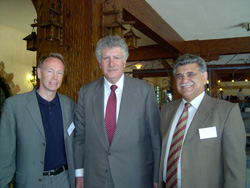
Tomas Hallberg, ECAD; Doros Theodorov, Minister for Justice; Andreas Petrou, Mayor of Aglantzia |
|
The ECAD 11th Mayors’ conference took place in Cyprus on May 20-21.
With 120 delegates representing 55 cities in 18 countries the annual Mayors’ Conference was a success.
ECAD had an honour to welcome Minister for Justice, Mr. Doros Theodorou, who on behalf of the President of Cyprus opened the conference.
This year program developed the general theme ”Fighting against drugs – a family issue?” and focused on different aspects of drug prevention and demand/supply reduction. These remain important issues for the discussions within the ECAD.
|
ECAD would like to thank the municipality of Aglantzia for hosting the conference, for the great share of speakers, for the hospitality shown throughout the conference!
ECAD would also like to thank all speakers and delegates who made this conference an important event of the new ECAD year.
The mayors’ conference is the major policy-making forum of the organisation. It meets annually so that elected representatives of European cities may consider the progress being achieved in the ongoing task of reducing the demand for illegal drugs and reducing the supply of such drugs to our city communities. Even though the conference is a formal event, it is also a great manifestation of our network co-operation and the growing social network!
Two Cypriot cities - Ayia Napa and Latsia, and the Russian city of Azov have signed the Stockholm Resolution and joined the network of the ECAD members.
Next year, we will continue our discussions in Oslo. Welcome to ECAD!
To read more about the conference, click here
|
March 4-5, 2004, Belfast
British drug policy - a betrayal
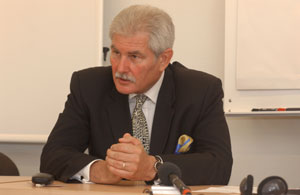 Keith Hellawell, Former British drug tsar
 |
|
Former British "drug tsar" Keith Hellawell went hard against the British line in regard to drug policy when he spoke at the ECAD conference in Belfast. "It’s a betrayal of our citizens, and most of all - of our young people", he said. "In spite of all knowledge, cannabis was reclassified as a less dangerous drug. This is a wrong decision, it lacks people’s support."
The decision to reclassify cannabis was taken by officials on a high level. Hellawell made out that the decision makers were steered by supporters of drug legalisation.
|
|
He named Mike Trace, his own former deputy, who has later been uncovered as a fifth columnist while working for the UN Office on Drug and Crime in Vienna. Trace advised Hellawell not to take part in the ECAD Mayors’ conference in Belfast in 2001. "According to Trace, to take part in that conference was not suitable for my position". Hellawell regrets today that he has listened less to "his intuition" than to his "poor adviser".
In his speech in the presence of 300 delegates at the Belfast City Hall Hellawell went trough some myths, among others, the one saying that almost all young people use drugs. Hellawell emphasised that this myth is dangerous. It is used as an argument by the drug liberals in their attempts to carry through their policy. One makes pretence that this is a natural state of affairs and continues that there is nothing to do about it but to be pragmatic. In reality, a much lesser part of population uses drugs regularly, even in Great Britain.
Hellawell resigned from his position as government’s drug co-ordinator just because of "the betrayal" as he calls the decision of de-facto decriminalisation of cannabis in Great Britain. He does not regret his resignation, maybe only that he did not pursue his policy harder when he served as the highest responsible for the drug issue in the country.
|
Advisory Board meeting Grants for study visits/for more info see menu to the left
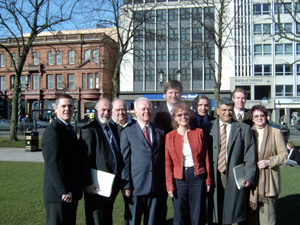 ECAD Advisory Board
 |
|
Belfast City invited the ECAD Advisory Board to attend the conference. In connection with it, a regular Advisory Board meeting took place. Among other decisions, the Board agreed that
- From 2004, ECAD introduces an opportunity to apply for a grant for a study visit to ECAD member cities.
- A joint ECAD/Swedish Carnegie Institute grant, 2000 Euro, will go to a person of a great merit within the anti-drug fieldwork in Russia to stimulate further research and improvement in the subject.(*)
|
- A campaign will be launched to make ECAD more known in France, Germany, Spain and Italy. Information materials will be translated into the named countries’ languages in order to better reach the addressees.
- The Advisory Board made a statement on the unsatisfactory state of affairs at the Amsterdam airport Schiphol.
(*)The project has never been implemented
|
March 2004, Stockholm
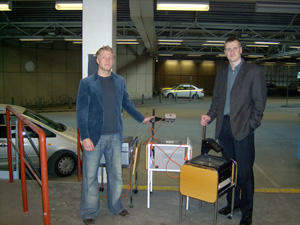
We thank the embassy of Estonia, that helped to transport 10 overhead projectors which will be distributed as prize among the winners in an anti-drug school project in Tallinn. |
|
|
|
|
February 26-27, 2004, Riga, Latvia
Widening of the EU boundaries - challenges and opportunities
|
|
|
- A deeper co-operation between the law enforcement agencies in the Baltic sea region is necessary for combating illicit drug trafficking in the region, says Walter Kegö, responsible for Customs and Police within the office of the Swedish National Drug Policy Co-ordinator, at a seminar in Riga, Latvia.
The second year in a row the heads for Customs and Border Police from the countries around the Baltic sea - Sweden, Finland, Russia, Estonia, Latvia and Lithuania - gather in Riga for a two-day seminar to share their knowledge and experience with each other. Besides co-operation in counteracting illicit drug trafficking, these meetings have another important dimension - considering the opening up of borders within Europe in May 2004.
There are differences in legislation and practical work which need to be bridged over. We have to get to know our strong sides and weaknesses to optimise the results of our co-operation.
A follow-up meeting will take place autumn 2004 - a conference where we would like to invite all main figures involved in the anti-drug policies and anti-drug fieldwork. The Swedish National Drug Policy Co-ordinator entrusted ECAD with the task to be an organiser for this conference.
"We have found a good partner in ECAD", continues Walter Kegö.
"ECAD has a wide-spread contact net, it is quick and non-bureaucratic in its management. We are united in our vision of a drug-free society".
|
January 24, 2004, Tallinn, Estonia
Conference "Schools without drugs"
|
|
|
On January 24, 2004 an international conference "Schools without drugs" was held in Karjamaa gymnasium in Tallinn.
The participants were Tallinn authorities, school teachers, social workers, police officers, school psychologists, parents and students.
We would like to thank you everybody who helped us to prepare and to carry out this conference: Tonu Karu and Vladimir Cook from Tallinn City Council, Tomas Hallberg from ECAD, John Slade, President of the Estonian Rugby Federation, Lord Calais from Tartu university, Pavel Starostin, Dannock from Salvation Army, Canada, Hanzhen Liu from "Parents against drugs", China, "Toots's room" ("Children's shelter"), Estonian Centre of Moral Health and others.
|
November 20-21, 2003, Malmö
Manifestation of the Swedish drug policy
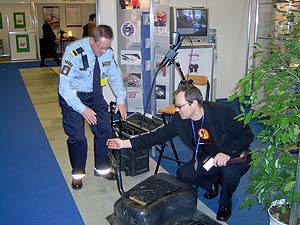 "George Zazulin at the Swedish Customs' booth"
 |
|
The "Sweden Against Drugs" fair was held in the Swedish city of Malmö on November 20-21, 2003. This event is, above all, a manifestation of the Swedish restrictive drug policy.
The first fair took place in 1993 in connection with Sweden's joining the EU. Since then, every other year, representatives of governmental bodies, public organisations and private institutions gather for two days to discuss current drug policy issues.
ECAD was present with its booth. ECAD's representative in Russia, George Zazulin, was invited to hold a seminar on Russian drug policies.
|
One of the actively disputed topics of today's Swedish drug policy is a question about the future of a needle exchange program. This program has been carried out for 17 years in Malmö/Lund as an experiment. Earlier this autumn the governmental drug policy co-ordinator suggested to make this experiment permanent and to give other counties opportunity to start their own needle exchange programs. This discussion has split the Swedish anti-drug field. Many consider these types of programs as concessions to the drug liberals' arguments.
Still united around restrictive drug policies are the majority of Swedish actors in the fight against drugs. This even though they have different understanding of how to implement these policies.
|
Report from Minsk, Belarus, November 2003
89 millimetres from Europe

|
|
Population: 10 million
Language: Belarusian, Russian
Capital: Minsk
Europe's geographical centre
Europe's political "blank spot"
ECAD has received from SIDA (Swedish International Development Co-operation Agency) 27,000 Euro for development of work in the field of drug policy in Belarus in 2004. This is the first year of a three-year project which is aimed at strengthening efforts in the combat against illicit drugs in the country and particularly to develop and support public organisations and their input. The project work will be carried out in co-operation with the Swedish organisation CRIS (Criminal's Return Into Society) and the Lithuanian AIDS Centre.
A first visit was made, in November 2003, to Minsk where we met with the organisation "Republic Without Drugs" which is ECAD's partner in Belarus. We also visited the Ministry of Health and the Parliament's commission on family and health issues.
During our official meetings both the government's and the parliament's representatives put stress on the facts that the Belarusian authorities have control over the drug situation and that the country supports restrictive drug policies. (Whow….Control!)
|
Åke Setréus, ECAD's project leader in Lithuania and Belarus, informed that Sweden can give support in combating drugs with experience in regard to co-ordination of efforts from state/public institutions. The Swedish way to deal with drug problems also includes comprehensive measures within prevention, treatment and control.
The first step in the project will be to make an analysis to create an information bank on public organisations/institutions active in the anti-drug fieldwork in Belarus.
The Belarusian project is guided by the experiences gained in Lithuania. ECAD arrived in Lithuania five years ago and started with analysing of what had already been done in that country. One of the concrete results of that project was the treatment centre Meikstu Dvaras. With its successful rehabilitation methods it now draws attention to Lithuania from the neighbouring countries. Our new Belarusian partner "Republic Without Drugs" have learned about ECAD through this centre.
ECAD hopes that some Belarusian cities will join our international network during the project. When the three Baltic states and Poland become members of the EU in May 2004, only an 89 millimetre's gap will separate Belarus from Europe…
"Belarus - 89 millimetres from Europe" is a book of the Swedish journalist Kjell Albin Abrahamsson; (89 millimetres is the difference of two standards widths for rails)
|
Global Drug Prevention Network
5th Global Conference on Drug Prevention, Rome, September 2003
|
The ECAD representatives actively participated at the 5th Global Conference on Drug Prevention that took place in Rome from September 22 to 26, 2003. Read the Declaration from the conference on "Conference papers"!
|
June 26-27, 2003, Bourgas, Bulgaria
Cities of Balkan region against drugs
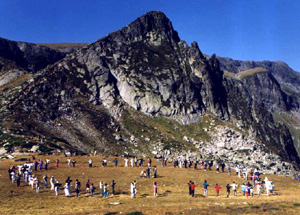 (Picture from www.bulgaria-italia.com)
 |
|
For two days, June 26-27, 2003, the city of Bourgas, Bulgaria, became a centre for discussion on illicit drugs in Balkan region. This city hosted the second international conference for the Balkan members of ECAD. 92 delegates from 16 cities in Bulgaria, Germany, Russia, Serbia and Montenegro took part in the event. The conference resulted in a Declaration, in which a wish to establish a network of Balkan cities has been confirmed. This network is aimed to further co-operation and experience exchange in the anti-drug fieldwork.
ECAD regards the establishing of such a network as an important step towards a healthier and safer city environment, considering the role of the Balkans in the fight against illicit production, trafficking and use of narcotic substances.
|
|
|
May 15-17, 2003
The ECAD 10th Anniversary Mayors' Conference in Stockholm
| |
|
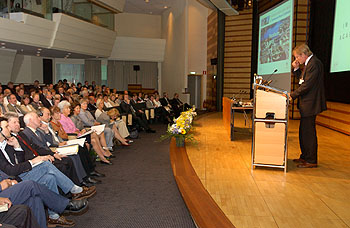
The ECAD 10th Anniversary Mayors' Conference took place in Stockholm on May 15-17.
With 220 delegates, including twelve Mayors and 13 Deputy Mayors, from 77 cities in 22 countries, the conference was a success.
Bringing together people from all corners of Europe for the conference was indeed a productive and rewarding occasion, with extensive opportunities for delegates to exchange views and experiences. ECAD would like to thank the City of Stockholm for hosting the conference and for the hospitality shown throughout the conference.
ECAD would also like to thank all speakers, delegates and others who made the conference a worthwhile experience.
Four Lithuanian cities signed the Stockholm Resolution, bringing the number of ECAD Member Cities to a total of 264.
|
Karlskrona 10 February
Seminar on drug policies
|
Karlskrona, an active ECAD member city, has arranged a one day seminar to discuss drug policies from European, Swedish and local perspectives. Tomas Hallberg, ECAD, gave an overview of the policies on the European scene. Björn Fries, the Swedish National Drug Policy Co-ordinator, concentrated on principals of the Swedish approach. Börje Svensson, Karlskrona drug prevention work co-ordinator and his colleague from municipality's alcohol and drug section, Sören Trolle, informed about local experiences in combating illicit drugs. The speakers agreed on that though common European and national strategies are important, the key role in combating illicit drugs was the attitude of the local community towards the drug problem. The latter is crucial to the success of any anti-drug measures.
Besides that, Walter Kegö, responsible for custom and police issues within the governmental Mobilisation Against Drugs Committee, spoke about ways illicit drugs are being smuggled into Sweden. Karlskrona which lies on the south-east coast of Sweden is located right in the middle of what is considered illicit drug trafficking routes. This due to its geographical position, at a node of shipping routes in the Baltic sea.
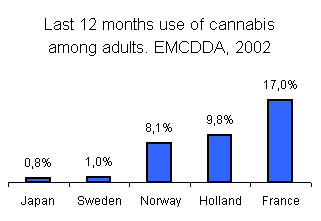
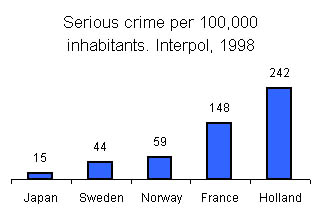
Illicit drugs misuse and violent crimes go together. It was one of the concepts that Tomas Hallberg brought up. To support it, he showed statistics with regard to the prevalence of violent crime and use of cannabis. The statistical data comes from countries with different approaches to illicit drugs and their use/misuse. Validity of such a comparison requires further research. None the less we can put forward the question whether or not this is by sheer coincidence that these curves overlap.
|
|
|
|
17 January 2003, Cork
European Parliament President is not a drug liberal
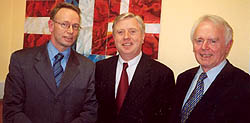 Tomas Hallberg, Pat Cox, Jim Corr in Cork
 |
|
Jim Corr, Chairman of the ECAD Advisory Board, and Tomas Hallberg, ECAD director, met the President of the European Parliament, Pat Cox on January 17, 2003 in Cork, Ireland.
On a direct question from Mr Hallberg Pat Cox answered that he belongs to the liberals in the European Parliament. 'Liberals hold different views in regard to drug issues, said Mr Cox, but I do not belong to the drug liberals'. 'I have not worked with drug issues but the matter seems fairly easy to me, Mr Cox continued. 'I do not want drugs in my family and I do not want them in the society.'
|
The representatives for ECAD and the European Parliament President discussed how the anti-drug policy questions can be pursued within the European Parliament. Mr Corr and Mr Hallberg have expressed their critical view on how the European Union's drug control organ, EMCDDA, is being run. Mr Cox responded that he does not know much about the subject, though if the criticism is relevant there are ways to investigate the question and to make necessary changes.
ECAD was first to inform about the scandal around former EMCDDA Chairman Mike Trace, who has also been employed as the Head of Demand Reduction at the UN Office for Drug Control and Crime in Vienna. Mr Trace who was the deputy 'drug czar' in the UK has, according to the information in mass media, been exposed as a 'fifth columnist' in favour of drug liberalisation movement. While occupying these posts, Trace was the spider in the web aiming at counteracting the UN Conventions on drugs.
We regret to inform you that, because of scheduled arrangements, Mr Cox will not be able to attend ECAD's 10th Anniversary Conference that will take place on May 15-17 in Stockholm. 'I would have liked to come. In order to show my support to ECAD efforts in anti-drug fieldwork, I shall send video greetings to the conference delegates, - concluded the President of the European Parliament.
|
ECAD-Sweden annual conference, Gävle, 20-21 November 2002
'Network ECAD-Sweden': strengthening of network
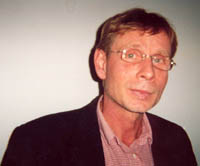 Björn Fries, National Drug Policy Coordinator
 |
|
'Network ECAD-Sweden' can be a promising initiative. It will be good when more Swedish counties have joined. These words belong to Mr Björn Fries, the Swedish government's drug political co-ordinator. Mr Fries attended the ECAD-Sweden annual conference which took place on 20-21 November in the city of Gävle. More than 100 participants from 26 Swedish counties had met to discuss drug policy questions. At present, 44 out of 289 Swedish counties have joined the network.
There is no contradiction between ECAD and the Swedish government's drug policy. Because of this they both win through co-operation. It is stated in the ECAD constitution that co-operation with different organisations and counties lies in the basis of its activities. ECAD, which unites people responsible for or co-ordinating drug policy questions in their cities and counties, provides therefore an excellent platform for mobilisation in combating drugs. These people are also practical ambassadors when meeting their colleagues from other countries to convey what the Swedish model implies with a restrictive drug policy.
|
|
|
St. Petersburg 25 October 2002
Press conference on the legalisation movement outshadowed by the hostage drama
|
In the middle of the hostage drama at the North-East theatre in Moscow, ECAD arranged a press conference on the spread of drug legalisation movement in Russia. Arkady Kramerev, member of the ECAD Advisory Board and the St. Petersburg Legislative Assembly, invited to a debate on the recent onslaught of the drug legalisation lobby. The background was that the fairly unobtrusive voices for a more liberal drug policy have lately grown increasingly strong. The Trans Radical party has established itself in Moscow and gained the support of various indepent politicians. Its activities have escalated during the past year, including among other things a lengthy article on the Internet about ECAD, describing who work for the organisation and why.
Russian drug policy has taken a turn during the last couple of years. Following Jeltsin's legalisation of drug consumption at the early 1990-ies, legal prohibition of drug abuse has now been re-introduced. Furthermore, there is a new legal paragraf which prohibits drug propaganda. As these laws are quite new, there hasn't been time to develop a practice for implemantation or sentence scale.
President Putin has decreed that a new drug commission shall have additional 200 officials who shall be responsible for implementation of the new drug policy. The commission is placed under the Ministry of Interior.
Despite the strictly restrictive official drug policy, the legalisation lobby poses an actual threat, maintain many local politicians. Of the new generation of younger politicians, many
have experimented with illegal drugs themselves. Lacking any deeper education on drug issues, these politicians are all too easily influenced by the Dutch drug policy.
- Drug issues are taken more seriously lately. Had not the tragic events in Moscow been the focus of media attention at the same time, we would easily have redoubled the number of participants compared to those fifteen who showed up, says Arkady Kramerev.
|
VIII International Rainbow meeting in San Patrignano October 9-11, 2002
Berlusconi: 'Zero tolerance on drugs!'
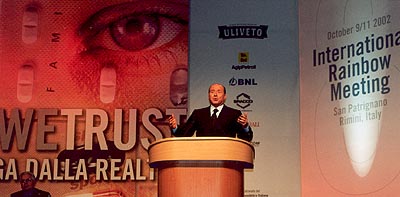
Italy's Prime Minister, Rt. Hon. Silvio Berlusconi
|
Italy's Prime Minister, Rt. Hon. Silvio Berlusconi, came out heavily against the past Italian drug policy in his speech in San Patrignano on 10 October. He called the harm-reduction programs which have been conducted in the country 'totally worthless', and stated that either you are against drugs, or else you are for them. Mr Berlusconi emphasised that individual freedom has nothing whatsoever to do with the freedom to abuse illegal drugs. About 8% of the country's population is affected by heroin, cocaine or amphetamine abuse. A strongly contributing cause to the weak policies according to Mr Berlusconi - and not only regarding drug issues - is the short life of the Italian governments. The average term has been one year since end of the World War II.
An audience of over 1000 participants listened to the one-hour speech which did not exclusively deal with drug issues. Mr Berlusconi declared that he is no supporter of methadone programs but prefers drug free treatment. Prime Minister and his 'drug czar' Pietro Soggiu mentioned some new measures to fight drugs which included, among others, more resources to the local police and reinforced drug information in schools.
Andrea Muccioli, the front figure of San Patrignano and son of the founder of the community, was very proud that Italy's leader attended the annual Rainbow conference. He was also pleased with the way the visit was conducted. Mr Berlusconi gave his address as the last speaker of the morning session. Mr Tomas Hallberg from ECAD had the honour to address the audience just before the Prime Minister. Furthermore, Mr Berlusconi participated in the two-hour lunch together with the delegates and members of the community. Usually, high decision makers' participation in drug political conferences is more likely to follow the 'first in first out' principle. 'Drug issue is a very important one, and therefore I am very sorry for not being able to stay longer', is usually the high potentates' excuse on their way to the waiting cars.
But this was not the case at San Patrignano. Bravo, Mr Prime Minister!
Facts: The mission of the San Patrignano community is to welcome and give back to normal life those people who are affected by drug addiction and outcasting problems.
The community is now a family of 1800 people, its main site is near Rimini, Italy.
www.sanpatrignano.it
|
4-5 October 2002
City of Düsseldorf hosts ECAD Advisory Board's autumn meeting
Fifteen Advisory Board members and staff of ECAD met on 4-5 October in the Düsseldorf City Hall. The Chairman Jim Corr welcomed Andreas Petrou, Mayor of the Municipality of Aglantzia, Cyprus as the newest member to the Board, and Aija Kalnaja as the new director of the ECAD Regional Office in Riga. Kristin Arnadottir from Reykjavik was unanimously elected to the Vice Chairman of the Advisory Board.
Among the items on the agenda were proposals for amendments to the ECAD constitution, which, after some minor adjustments, the Board agreed the recommend. The most important subject of discussion was however the planning of future activities. As ECAD today is fairly strong in the northern and eastern parts of Europe, great efforts should be made to strengthen ECAD in the Southern Europe along with the Balkans. Negotiations are already under way to establish ECAD in Sarajevo, Bosnia.
Next year's Mayors Conference in Stockholm on the 15th through to the 17 of May 2003 will mark the tenth anniversary of ECAD. The Board stated that it is time to look back and sum up what we have achieved, and gather European decision makers at the highest possible level to lay down the guidelines for future.
Furthermore the Advisory Board was given a both practical and theoretical overview on how Düsseldorf deals with drug issues. We thank our gracious hosts in Düsseldorf for a very well organised meeting.
More pictures |
27 September 2002
World Forum on Drugs: Legal and illegal drugs should 'exist' no more
|
From HNN's correspondent in Montreal
After a week of deliberations the World Forum on Drugs in Montreal came to an end on Friday, 27 September.
The World Forum had all the ingredients that can be expected at a meeting this seize, gathering some 3 000 participants from all over the world - anything from evidence-based scientific information, via quasi-scientific wishful thinking and drug political intrigues, lobbying, and networking to final recommendations.
During the week there were over 200 regular sessions dealing with various aspects of drug related issues. There was no way any participant could get a complete overview about what was going on, let alone participate in all the events.
The regular sessions were based on the seven major themes of the World Forum:
1. Policy, base-lining and benchmarking
2. Social, cultural and health issues
3. Populations
4. From global to local issues
5. Scientific, technical and educational issues and challenges
6. Setting focus
7. Substances and dependencies focus
The world Forum concluded with a synthesis of the results based on input from only 50 per cent of the regular sessions.
The moderators of the session dealing with conclusions and recommendations, Ms Louise Nadeau of the University of Montreal and Mr Sandeep Chawla of the UNDCP (United Nations International Drug Control Programme), started their presentation by describing the two prevailing dichotomies in drug policy - prohibition and legalisation.
Participants were told that it was time to 'reframe our thinking, which is the best way to eliminate the polarities.'
Consequently we should, according to the moderators, no longer talk about legal drugs and illegal drugs, but rather 'psychoactive drugs'. We should no longer talk about prohibition and legalisation but rather about 'degrees of regulation'. Furthermore, delegates were told to leave the division into supply and demand problems and 'look at supply and demand as a continuum'.
The message seemed to be that everybody should work together - no more polarities, no more dichotomies, no more supply and demand quarrels. Let us instead reframe our thinking and look at the various degrees of regulation and the beautiful continuum, was the message.
This is sheer nonsense and no more than a drug political exercise to try to conceal conflicting drug political views by trying to rename them in order to give them a more neutral look, very much in the same way as when injecting rooms and distribution of heroin all of a sudden became harm reduction measures instead of remaining what they have always been and always will be - harm production.
There is no need whatsoever to change the terminology. Legalising cannabis is legalisation of cannabis. Non-legalisation of cannabis is prohibition. That's it! That should not be too difficult to understand for anybody.
The polarities exist, the dichotomies exist. Don't let yourself be fooled by terminology!
A fortune teller is a fortune teller even if you reframe your thinking and call him/her a CB Dr. (Doctor of Chrystal Balls). Somebody sweeping the streets remains doing the same thing even if you call him a hygiene technician. He still sweeps the same shit!
Talking about degrees of regulation won't make any difference when it comes to the contents of what is being done - A legaliser will remain a legaliser, or a and a prohibitionist a prohibitionist.
Drugs regulated through the UN Convention on Drugs are regulated because they are dangerous. They did not become dangerous because they were regulated.
In order to achieve a balanced and integrated approach, which was the ultimate objective of the World Forum on Drugs, it would have been much better if much more time had been devoted to discussions concentrating on improving the situation for people affected by drugs rather than descriptions of projects of various sizes, the medicalisation of the drug issue and changing the language we use when talking about the drug problem.
HNN International Centre
|
19-20 September 2002
HRM Queen Silvia of Sweden opened conference on AIDS in Vilnius
Saulius Chaplinskas, member of the ECAD Advisory Board, acted as a host for the fourth European conference on AIDS 19-21 September 2002 in Vilnius, Lithuania. Over 300 participants from many European countries met to discuss different approaches towards combating the HIV/AIDS.
The complexity of HIV/AIDS problems is strongly associated with misuse of drugs, particularly in the East European states. That was one of the reasons why ECAD was among the other sponsors of the conference.
The organisers should receive a big gratitude for the high level of the organisation in regard to both contents and invited speakers. Arturas Paulauskas, Chairman of the Parliament of Lithuania, and Queen Silvia of Sweden opened the conference.
Afterwards Queen Silvia visited a prison and an orphanage (see pictures under "Activities, ECAD photos"). Each step the Queen made in Lithuania and the conference itself received full coverage in the Lithuanian mass media.
Dr Chaplinskas had endeavoured to invite speakers from different camps within anti-drug politics. Due to this there were many intense discussions. During one of which Tomas Hallberg from ECAD discussed 'harm reduction' programs with the 'prophet of methadone', Robert Newman, from the USA. Mr Newman who is responsible for methadone treatments of 1800 patients could agree with Mr Hallberg on one thing, namely that methadone is not a solution for drug problems. Mr Newman remained of the opinion that a methadone program 'is better than' to do nothing. This, while Mr Hallberg went on to oppose this line of the reasoning with the argument that one should strive for not only better solutions, but for the very best solutions (the entire address is available under 'Conference papers').
One more Swedish organisation sent its speaker to the conference, 'KRIS' (Criminal's Revenge in the Society). KRIS helps to build a functioning treatment centre in Lithuania. A sister organisation has already been established and started to work on the project financed by SIDA which is aimed at those who has committed crimes and has serve his/her sentence to begin a new meaningful life outside the walls.
|
September 11-13, 2002. Conference in Kothla-Jarve, Estonia
International co-operation contributes to finding effective ways in combating drugs
The city of Kothla-Jarve, one of the ECAD member-cities in Estonia, makes a lot of efforts to combat drugs in the region as it was reported on the first international ECAD conference in Estonia. The organisers of the conference invited speakers from Great Britain, Latvia, Lithuania, Russia, Sweden and the hosting country to share their experiences with each other. Despite the fact that Kothla Jarve is a relatively small town with about 50,000 inhabitants, the municipality has realised that the experience exchange when it comes to combating drugs is an important step in dealing with the situation.
Drug misuse has increased avalanche-like not only in Kothla-Jarve but also in the country in general. According to their research, which was conducted in the city, about 44% of young people at the age of 14-17 have tested some kind of drugs. This represents an increase of nearly one hundred percent during a few short years. The situation is particularly difficult among the Russian-speaking population which makes up almost 80% of the country's inhabitants.
The city has, in spite of limited resources, created a developed infrastructure for free time activities for young people. There is some 1,600 square meters renewed locations for sport, music, art and internet. There is also three swimming pools and one ice hall. The idea is to open alternatives for the youngsters in choosing life without drugs.
The conference concluded with a discussion on what should be improved in the city's fight against drugs. The organisers will summarise the discussed ideas and form concrete proposals.
|
September 10th, 2002
Wide attendance and media coverage in Sarajevo when the first city in Bosnia/Herzegovina joins ECAD
NBV (Temperance Movement's Educational Association) through its local project leader in Sarajevo, Fadila Jasarevic, invited ECAD to Bosnia to discuss drug policy at a one-day conference. Representatives for 15 cities participated in the event and showed great interest in the subject. Drug problems among youth have quickly escalated since the end of the war, and more and more politicians have become aware of that something has to be done.
Several of the participating mayors were anxious to increase international exchange of knowledge, or, with the wording of one of the mayors: 'If you are looking for a football coach, you should look into the league which plays best'.
Tomas Hallberg described ECAD's history, aims, activities, the Stockholm Resolution, membership and function as well as the structure of the organisation.
He also accounted for Swedish experiences of methadone treatment and the Nordic approach to drug policy. By joining ECAD, the city in question adheres to the UN Conventions on Drugs and a restrictive drug policy. By signing the Resolution, the city declares its willingness and commitment to strive for a better society, a society without drugs.
ECAD offers exchange of experience between different European cities which aim at the same goal. This exchange of best practices includes both parents, elected decision makers and experts on the drug field. ECAD members get the possibility to participate in meetings, seminars, conferences and projects organised by ECAD.
ECAD's main event is the annual Mayors' Conference, which also is the highest decision making body of ECAD.
Conclusions from the conference:
All participants support a restrictive policy in the fight against drugs.
- They all are against legalisation of drugs
- They will present information about ECAD at the municipal level and urge their cities to join ECAD
- They will, at every level, initiate and develop a governmental strategy against drugs
On August 22nd the City of Maglaj decided to join 'the European association European Cities Against Drugs', and thus became the first Bosnian member of ECAD.
Media covered the whole event, both federal and cantonal TV reported from the
conference and broadcasted interviews with various participants. Fadila Jasarevic got some ten minutes live broadcast in the information program Paralleller of the Bosnian/Herzegovinian TV 1. Radio Stari grad and Radio Bosnia/Herzegovina P1 sent a half an hour program about NBV's activities and the ECAD conference.
Representatives for following cities participated in the conference:
Banja Luca (Jovanic Dusanka), Bijeljina (Slavko Blagojevic, Nada Babic, Dragomir Peric),
Brcko (Miroslav Gavric, Fatima Dedeic, Ranko Nastorovic), Bihac (Goran Stambolija, Senahid Nuhanovic), Gorazde (Sanid Zirak, Alija Lapo), Kozarska Dubica (Marija Ancic Zgonjanin), Livno (Marijana Dzal), Maglaj (Mehmed Bradaric, Eldina Mehinagic), Prijedor (Olivera Rosic), Sarajevo (Zlatko Cardaklija, Dzemal Murga), Tomislavgrad (Zlatko Prka),
Trebinje (Ljiljana Perovic, Biljana Leric)
The conference was also attended by Izet Serdarevic, Ambassador of Bosnia in Sweden (1998-2000) and Azra Karabegovic from NBV Sarajevo.
|
5-6 September 2002
More time for children: Recurring theme at the conference in Drammen, Norway
|
On September 5-6, 2002, Drammen's commune hosted a conference on the subject of youth and drugs. The town, which lies one hour from Oslo by train, has been an active member-city of ECAD for many years.
Laila Dåvöj, Children and Family Minister in Norway, emphasised that more time for children is one of the fundamental concepts in the Norwegian government's youth policy. She showed convincing statistics that alcohol consumption and misuse of drugs had both decreased during the last couple of years. The government concentrated on support to public organisations which work in the field and put efforts into development of co-operation between communes.
ECAD director, Tomas Hallberg, was invited to show positive results and interesting methods in combating misuse of drugs among young people. He chose Reykjavik, Iceland, and Västerås, Sweden, as examples. Icelanders have put the family in the centre and have managed to curve the misuse of drugs among adolescents at the age of 15-16. In the framework of the project "Drug-Free Iceland", research has been carried out which showed that the more time teenagers spent with their parents the risk that they would start with drugs became less. These findings have become a basis for the project work.
|
In Västerås, one police and one social worker have since 1999 worked to teach adults at schools to reveal earlier signs of misuse of drugs among theirs students. They have now received support from a centre which specialises in counselling, along with lessening drug use dependence and regular drug testing.
These projects are good examples of how one can build projects with the help of communal authorities to reveal and to stop the misuse of drugs at the first signs of misuse.
|
8 August 2002
Kiev municipality welcomed ECAD
|
The ECAD director Tomas Hallberg visited Kiev, the capital of Ukraine, on the 8th of August to persuade the town of two million inhabitants to join ECAD European network. There is no Ukrainian city which has signed the Stockholm resolution so far. ECAD regards Ukraine with its 50 million people and central location in Europe as a very important region in drug-related issues.
|
The Swedish embassy in Kiev helped to organise the meeting with the municipality and assisted with translation. The vice mayor of the city of Kiev, Oleksandr Yakovenko, explained the situation with illicit drugs in the city (according to the chief expert in narcology, there is 7000 registered drug addicts in Kiev) and the city authorities' drug policy.
The city's drug policy is oriented towards the harm reduction approach and there is a wish to find a third way between a restrictive and liberal view on the problem. Mr Yakovenko showed an interest in ECAD work asking many questions in order to receive a full picture of what the organisation is doing and what it stands for.
The meeting concluded with a decision that Kiev shall consider becoming a member of ECAD. Mr Hallberg, from his part, promised to invite Kiev's representatives to upcoming ECAD conferences as observers so that they can form a better opinion of the organisation's work.
|
27-28 June 2002
Visit in Vienna
On June 27-28, Torgny Peterson, ECAD Ass. Director, visited UNDCP at the International Centre in Vienna, Austria, for discussions with representatives of various senior offices, including:
- Bernard Leroy, Senior Inter-Regional Adviser of the Legal Advisory Program
- Sandeep Chawla, Chief of the Research Section
- Jonathan L. Lucas, Secretary, Commission on Crime Prevention and Criminal Justice Commission on Narcotics Drugs; Chief, CND Secretariat Section
- Tim Carlsgaard, Senior Public Information Office at the External Relations Unit
- Timothy Lemay, Officer-in-charge, Global Program against Money Laundering
- Irka Kuleshnyk, Crime Prevention and Criminal Justice Officer, Terrorism Prevention Branch (TPB/ODCCP).
|
June 2002
The ECAD office has moved!
Visiting address:
Klarabergsviadukten 63
21 May 2002
Jönköping, Sweden: Hearing on drugs
|
On May 21st, 2002, Jönköping's commune arranged a hearing on drugs. The target group was the staff and politicians from the commune's committees of social welfare, schools, child care and culture. The goal of the hearing was, through the knowledge and experience of different actors in the field, to shed light on drug situation in the commune and to discuss how the combating of drug problems should proceed. Representatives of ECAD, Swedish cabinet office, police, county council, social services and youth shared their views of the drug situation in the region. During the final discussion, the participants emphasised the importance of a zero-tolerance attitude towards drugs to stop new recruiting and the necessity to create a counter-offensive against the negative tendencies in development of the drug situation in Jönköping.
Jönköping is a town of 53,000 inhabitants
Erik Kangeryd
|
May, 6-7, 2002 Stockholm, Sweden
Conference on the Primary Prevention Of Drug Abuse in Big Cities
ECAD builds network against drugs
Two organizations, ECAD and PRECENS (Prevention Centre Stockholm), carried out a conference on the Primary Prevention of Drug Abuse in Big Cities on 6-7 May 2002 in Stockholm. More than 50 participants from 21 European cities took part in the conference.
Dr. Sven Andreasson (City-Project) introduced the results of the research on the effects of drug preventive work in Stockholm. There are examples of both successful and ineffective activities. Among the failures are many school programs which have no significant effects on youth's drug habits.
Prof. Thorlindsson from Iceland recounted the 5-year project "Drug-Free Iceland" that finished on March 1st, 2002. The report from Iceland presented positive developments: Iceland showed decreasing statistics in regard to all drug issues. Less young people tried illicit drugs, the debut with alcohol came later, frequency of alcohol consumption had gone down.
This is a sensation: one country has shown that well co-ordinated efforts by different actors could reverse a destructive development. Many countries could learn from the Icelandic experience.
During the conference Oslo, Warsaw, Cork and Vilnius reported about their preventive activities. The representatives of the participating cities have shown many new working methods in drug prevention. Their experience could be used in many different cities.
During the conference there was great interest in continuing co-operation between cities in their preventive work. The participants noted that there is a need for a follow-up conference. It is planned to take place in Vilnius in September 2002.
For more information contact the ECAD office in Stockholm:
Paulina.lonnroth.2@stadshuset.stockholm | |