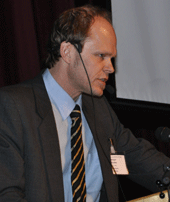
As this is an ECAD-conference I would like to take the opportunity to shortly inform you about a few current issues in our organisation.
Let me start by telling you that we had some very fruitful discussions the day before yesterday in the Advisory Board as well as yesterday in the Plenary Session. The world is moving all the time so it is important for ECAD to move as well.
This does not mean that we change direction, but that we move ahead. In ECAD there is no discussion whatsoever to change the fundament for the organisation.
ECAD propose restrictive policy, in strong support for the UN Conventions on illicit drugs. We believe in a holistic approach and that a restrictive policy must be combined with humanity. We will continue to be a strong voice in the European debate about this, because this is what unites the 266 cities that are members.
In 2008 ECAD will, amongst our regular activities, create educations for professionals, a master, in cooperation with the universities in Örebro, Reykjavik and St. Petersburg, hopefully even in Glasgow and Milan.
We will have conferences in Tallinn, Athens and Malmö on various topics and we will create a Scientific Committee that will assist ECAD with knowledge, well-tried experience and evaluated methods.
This Committee is of great importance to ECAD, as we strive to more than in the past take our starting point in knowledge and to support our member cities with best practice.
We will do this within the framework of a restrictive policy, leaning on the UN Conventions.
As I said, this is a development of ECAD – not a change in direction.
This business we are all in is not the fanciest one and we sometimes find it difficult. Often we feel that we are not making any progress or at least not as much as we want to. By listening to the encouraging and spiritual speeches yesterday, at least I fell a whole lot strengthened.
We must never forget that what we do, makes change. When society mobilise against drugs, when we react, it has great impact on people’s behaviour. We must never forget that.
Drug problems are, as you all know, measured in a number of ways and we are flooded with statistics on the topic. Every time we see a major change in the curves – if testing goes up for instance – you can link this to a change in policy.
You will notice that there has been a change in the way societies approach the problem; a more liberal policy or just lack of engagemen.
If testing goes down it has to do with a more restrictive policy, a more engaged society. This proves to me that what we do is important and that we can change unwanted behaviour.
Mr. Mack mentioned yesterday the successful fight against tobacco – an often used example – which evidently shows that it is possible if we show commitment, choose functioning methods and give the task enough resources.
In our struggle against drugs we can and must accept that cities choose different methods. As long as they are in accordance to the UN Conventions it is not a problem. If they are violating the Conventions, this has to be discussed, but what is most important is if the cities using them do that with an honest aim to fight drugs. That is what should be recognised.
Too often we who believe in a drug-free society tend to combat each other because of the methods used, rather than to see all the ingredients that unites us.
I fear that the ones that gain the most from our internal fight, is the liberalisation or legalisation movements. We must of course discuss methods but let us not forget that we support the same team!
Having said this, one must stress the importance of methods, models or programmes used to be based on knowledge, on evaluated or proven experience.
We know that some methods used today – with the best of intentions – in the worst case can be contra productive.
When Sweden in the mid 1960’s, to take one example, came up with the idea of solving the growing problems with amphetamine with legal prescription of amphetamine – it was for a very good reason. It was not proposed merely by drug liberals or the legalisation movement, but as an efficient way to reduce the problem.
The dilemma was that it nearly doubled the number of amphetamine abusers in a very short period of time. Thus, it is important to be engaged and committed, but we must also know what we do.
The only way to do this is to found our interventions on knowledge-based models.
In our work, we must again and again emphasise the importance of cooperation within and between cities, professionals and structures. One can do a lot alone but together we can make significant progress and improvement. We must learn from each other if we are to achieve real change.
In the ECAD-cities there are a huge amount of knowledge and yet lack of knowledge. If every city were to use the most successful models – we could certainly make significant reduction compared to how we perform today.
ECAD strives to fill this gap between cities wanting good examples and the ones with good role-models. We strive to connect policy-makers, experts and practitioners in order to get result.
Today we launch a Declaration that strongly supports the UN Conventions on illicit drugs as well as a support for a continued restrictive policy. I believe this is the only successful way to reduce illicit drug. We have some proofs for that.
Now, I do not want to point out different countries by this example, but the fact is that the young adults in the city of Malmö, in the southern parts of Sweden, some 8-9 % have tested drugs.
In the municipalities in the northern parts of Sweden the prevalence is a little bit lower in the same target group, some 5-6 %.
As Sweden is a very long country, it is a huge distance between the compared cities, but not when it comes to prevalence.
The distance between Malmö and Copenhagen in Denmark is about 20 minutes.
In Copenhagen some 35-40 % of the young adults have tested drugs.
Why those big differences?
For me it has nothing to do with the weather, language or anything else but the fact that Sweden since years has a restrictive drug policy. Denmark has a much less restrictive policy.
In a restrictive society everyone knows that is not accepted to do drugs. The reason the vast majority in Sweden does not test drugs is not because it is illegal – which of course is a clear message – since it is as illegal in Denmark. No, it depends on the negative attitude towards drugs in general. It is simply unacceptable.
In the declaration mentioned we also stress the importance of fighting cannabis. I consider this very important. Unfortunately cannabis, being the first illicit drug for the vast majority of drug abusers and the most common illicit drug in a number of European cities and elsewhere, is too seldom highlighted. Too often it is regarded as a soft drug that needs less action in many societies.
Let us face fact:
Fighting drugs is not rocket science. It is, in the end, very much a question of commitment, resources and readiness to learn, not the least from each other.
ECAD will continue to show engagement, to try to get the issue high up on the political agenda and to spread knowledge among our member cities. I hope you will all join us.