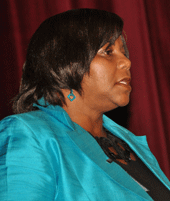
Honourable Lord Mayor Linder,
Honourable Mayor Anneli Hulthén
Honourable Mayors,
Honoured Speakers
Distinguished Guests,
Allow me to extend the warm and cordial greetings of the people of Nelson Mandela Bay in South Africa to all the citizens of our sister city, the City of Göteborg, and to all esteemed participants at this World Mayors’ Conference on Drugs.
It is indeed an honour and priviledge to address you in this August gathering of the World Mayors’ Conference on Drugs 2009. Thank you.
As part of the international community of nations, we come to this conference with the common purpose to exchange information, ideas, and forge stronger partnerships through the sharing of our local government experiences and perspectives.
Thus, it is often said that we bring to these gatherings our own counter drug-cartel whereby, we will together plan and devise strategies that will put a spanner in the works of those who flagrantly plot the disintegration of our social fabric.
There can be no doubt that we in local government have a very direct and unique role in confronting alcohol and other drug use (AOD) – related problems and as local government we are strategically located to respond directly to these problems through multi-sectoral approach that acknowledges the role of government, business and community based organizations to establish a formal partnership to adress the challenges.
We, in the Nelson Mandela Bay Municipality believe that such cooperative intergovernmental relationships are key to the success of fighting this scourge.
This conference is indeed a confirmation of the inveterate commitment and dedication that the Mayors of the democratic and free world are wholly united in combating and preventing the proliferation of illegal drugs and substance abuse, with the specific intent and relevant response to the prevention of substance abuse in our respective cities.
Ladies and Gentlemen:
Let me start by analysing the drug problem in the Nelson Mandela Bay, which comprise Port Elizabeth, Uitenhage, Despatch and Colchester – in order for this conference to have a clear understanding of the nature and extent of the problem, show its impacts and how we address the challenges.
The Nelson Mandela Bay Metropolitan Municipality, like the rest of the cities in the world is confronted with the ever increasing phenomenon of substance abuse and drug trafficking.
Although accurate and current statistical data on the use and abuse of illicit drugs in South Africa are difficult to obtain, the statistics of the World Health Organisation (WHO), the Medical Research Council of South Africa (MRC) and local findings are highly disturbing.
Dagga and alcohol are still the most abused substances in South Africa. Estimates are that 2,2 million people use dagga or cannabis.
In the second category are cocaine, heroine, speed, LSD, hashish, ecstasy and metamphetamine (”tik”).
Dr. Charles Parry of the Medical Research Council of South Africa indicated that treatment demand for dagga-related problems as a primary drug of abuse has increased by 11% points.
In South Africa, a study conducted by the MRC in selected treatment sites showed that the use of cannabis (”dagga”) and Mandrax (methaqualone) alone or in combination (”white-pipes”) continues to be high.
Between 13 % of patients in Port Elizabeth attending specialist treatment centres had cannabis as their primary drug of abuse compared to 25 % for Mandrax.
The treatment forcocaine-related problems remains low in the Port Elizabeth area.
Organisations/Individuals involved with the treatment of Substance and Drug Abuse in the Nelson Mandela Bay:
- Nelson Mandela Metropolitan University
- Youth for Christ
- Department of Social Development
- Welbedacht Treatment Centre (in-patient)
- Shepherds Field Rehabilitation Centre (in-patient)
- Graceland (in-patient)
- South African National Council on Alcoholism and Drug Dependence
(SANCA – Port Elizabeth)
- Department of Health
- Nelson Mandela Bay Municipality
- South African Police Services (SAPS)
- Cacadu District Municipality
- Christelike Afhanklike Bediening/Dienste (CAB/CAD)
- Ivo Vanekeirbilck
- DOXA
- 2 SHARE Support Group (John Preller)
- Local Drug Action Committee (LCAD)
- Rei’s Place (Secondary Care Centre ”Halfway House”)
- Rama Rescue
- SAPS Humewood
- Business Against Crime (BAC)
- Maranatha
- Ikamva Youth Trust
- Department of Education
- Alcoholics Anonymous
- Hunters Graig Private Psychiatric Hospital
- National Institute of Crime Prevention and Reintegration of Offenders
- Family Institute of South Africa (FAMSA-Port Elizabeth
In the Easten Cape Province of South Africa, the main primary substances of abuse reported by the treatment centres from July – December 2007 were alcohol, cocaine and cannabis. The proportion of patients reporting cocaine as their primary substance has increased alarmingly since 2004, reaching a peak of 23 % in this reporting period. During this period 608 persons were treated across the six treatment centres that collected data in the Eastern Cape Province.
The costs and implications for government and society:
According to the World Drug Report of 2006, the approximate number of problem users in South Africa is more than 200 000.
Close to 9000 problem drug users were treated at 73 treatment centres from June to December 2006.
Considerable abuse of over-the-counter and prescription medicines is also reported. These include pain relievers, tranquilizers, cough mixtures and slimming tablets, as well as solvents such as glue.
An alarming statistic gathered from the Report indicates that South Africans are much more likely than any other country’s citizens to cause injury or death to themselves and to others
- often friends or family – when intoxicated. The consequences of alcohol abuse are everywhere: from women who drink so much during pregnancy that their children are born mentally disabled, to young people who smoke dagga behind the school walls.
In a World Health Organisation (WHO) study in 2007 on the relationship between alcohol and injuries, conducted among people admitted to emergency rooms of 12 medical centres in 12 countries, South Africa had the highest number of injury cases where alcohol was consumed in the six hours before admittance.
Notably, the social cost of illicit drug use has not been officially calculated, but up to 12 million family members of drug users face emotional and financial strain. A conservative estimate of the economic costs to South Africa of alcohol abuse, based on research studies conducted in other countries, is between 8,7 billion rand and 17,4 billion rand per year.
The social costs are also enormous. About 11 million family members have to endure the turmoil of living with problem or risky drinkers.
Risky drinking affects 17,5 million South Africans. It is estimated that alcohol abuse is a factor in nearly half of fatal road crashes in South Africa.
This result is a cost to the country of around 7000 lives annually.
The National Institute of Crime Prevention and Reintegration of Offenders (NICRO) have reported that alcohol contributes substantially to the high incidence of crime in the country. The Medical Research Council (MRC) has found that alcohol has a negative effect on the business community due to absenteeism, poor productivity, high job turnover, interpersonal conflicts, injuries and damage to property.
South Africa, for a number of reasons, is experiencing an increase in substance abuse and is associated problems. The major reason is the social and political transformation and also the strategic position of the country with good infrastructure that allow easy access into the country through our borders.
Currently, the Nelson Mandela Bay community is challenged by the problems of gangsterism, violence and drug abuse. Young children fall prey to drug-related gang violence on a daily basis.
Recently, the Nelson Mandela Bay community is challenged by the increase of Methamphetamine (Tik) abuse.
The age of patients, who reported Methamphetamines as their primary substance of abuse, was on average between 15 and 20 years. Almost 65 % of patients are younger than 20 years.
Children in the Nelson Mandela Bay are now starting to take drugs and alcohol at a younger age than before.
This statement has been proven by several surveys conducted by local organisations on drug and alcohol abuse among children in the Nelson Mandela Bay Metropolitan area.
One fifth of all primary school children reported to have tried drugs.
The average age of first starting to use drugs is 12 years.
A study conducted in schools among high school learners indicated that children are using drugs more frequently. The risk behaviour identified among learners was cigarette, alcohol and cannabis (dagga) use, which had seen an alarming increase in its use.
Now children are using harder drugs. Heroin use increased significantly in NMB.
During the mid to late nineties, less than 1 % of people seeking treatment in the NMB had heroin as their primary drug of abuse, by the turn of the century, this had increased to more than 5 %.
I would also like to share with you trends identified by the SACENDU project: the trends show that alcohol is widely misused by South African youth. Alcohol is the second most common primary substance of abuse. Binge-drinking appears to be the most common form of substance abuse amongst school going youth of both genders.
The high rate of binge-drinking is cause of concern given the significant association between alcohol abuse and academic failure as well as the link between binge-drinking and high risk sexual behaviour. Given the high HIV/AIDS infection rate among young people, interventions are required that address the association between binge-drinking and high risk sexual behaviour.
Alcohol remains the dominant substance of abuse in NMB. Research conducted showed the increased prevalence of Foetal Alcohol Syndrome (FAS) among young learners.
Research has also shown a strong link between drug use and HIV/AIDS. Risky sexual behaviour, such as engaging in multiple sexual partners and unprotected sex has been confirmed to spread HIV. The abuse of alcohol is increasingly being recognized as a key determinent of sexual risk behaviour and consequently, an indirect contributor to HIV transmission. Injecting Drug Use (IDU) has also proved to spread HIV. Although its prevalence is still low it is an indication that it could explode in the future.
In concluding the nature and trends of drug abuse, it is important to remark that perhaps the greatest negative effect of drug abuse is that it slows down or stops emotional and psychological development, preventing people from reaching their potential. Added to this is the burden placed on society by health care and Criminal Justice costs related to substance abuse, as well as the costs associated with decreased productivity in the work place, increased HIV/AIDS transmission and domestic violence to name but a few.
How do we deal with the drug problem in South Africa and in particular the Nelson Mandela Bay?
In South Africa we adopted the National Drug Master Plan (NDMP). This policy document acts as a barometer of time commitment and performance of the South African Government and its partners in the field of substance abuse. The main objective of the NDMP is to form a united front of all stakeholders in the country and in the Eastern Cape Province to joint action towards a society free of drugs and its related problems. The challenge of curbing substance abuse requires a coordinated, multi-pronged effort, including legal, health and socio-economic responses.
A Provincial Substance Abuse Forum coordinating structure that oversees efforts of all the various sectors had been established to ensure an integrated effort to combat the incidence of substance abuse, in terms of the NDMP and the Prevention and Treatment of Substance Abuse Bill which replaces the outdated Prevention and Treatment of Drug Depency Act, No 20 of 1992.
The main aim of the Bill is the combating of substance abuse through prevention, early intervention, treatment and reintegration programmes. Particular attention is given to interventions that target young people to equip them with necessary skills to resist the urge to experiment with drugs. One such programme is the ”Ke Mojo”. This programme is run in partnership the United Nations Office for Crime oand Drug Control, Provinces, Religious Sector and Civil Society.
The Bill emphasizes the role of the community and community based organizations as a crucial link in the prevention of substance abuse and provision of substance abuse-related services. This represents a significant shift from the traditional approach to treatment in that it recognizes the vital role that the family, friends and the community in general can play in substance abuse intervention.
Government is fully aware that the fight against drugs and drug-related crimes cannot be won by the police or government alone. By involving our communities and young people in projects such the Ke Mojo campaign and the implementation of the National Youth Service Programme, we acknowledge the vital role that youth play in our society.
The composition of this forum involves all role-players in the field of substance abuse: Treatment and Aftercare; Prevention and Education; Community Development; Legislation; Law Enforcement, Policy making, Research and Information Dissemination.
In addition, the business community and any other structures interested in addressing substance abuse are allowed to participate.
The main function of the Forum is to strengthen member organizations in carrying out their existing functions to directly or indirectly address the substance abuse and to keep substance abuse high on the public and political agendas of the province. This is done through coordinating and formulating a strategic plan of action for the whole province.
The Forum further encourage networking and a effective flow of information between members of the Forum; encourage member organizations to contribute to and remain abreast of research and developments in the field of substance abuse prevention and treatment; establish and strengthen the Local Drug Action Committees (LDACs) in their tasks; and encourage accepted prevention strategies in communities.
In turn the Central Drug Authority in South Africa (CDA) as the statutory coordinating body in the country for substance abuse issues liaise and interact both with the Provincial Substance Abuse Forums and Local Drug Action Committees (LDACs), in answering to Parliament on the implementation of the NDMP.
I must also mention that Government through the Department of Social Development, supported by the Central Drug Authority and the United Nations Office on Drug Control, initiated the ”Ke Mojo” Drug awareness campaign which are aimed at reducing the demand for drugs among youth, and empowering them to make informed, responsible choices in order to resist the pressure of taking illicit drugs.
This campaign is also aimed at increasing their awareness and understanding of the dangers of alcohol and other drugs.
Now that we know what the extent of the drug problem is and have a sense of the functioning of the Substance Abuse Forums, the question still remains on how best we can put the mechanism in action or what can be expected from us:
First of all, the realization and commitment to become and integral part of the solution to the subtance abuse problem. Secondly, to avail ourselves and our city resources to actively participate in the activities of the established Substance Abuse Forums in order to ensure effective strategic planning and the co-ordination of activities.
Ladies and Gentlemen:
The scourge of drug and substance abuse has increased amongst the youth, and it demands concerted effort by all stakeholders involved in the field of substance abuse to take bold steps to reverse the situation. It is evident that youth and children start using substances at a very early age, and it is a challenge for this Conference.
In my City treatment facilities for the youth are still a major challenge, and I urge this Conference to strengthen local initiatives and programmes which are in line with the approved norms and standards for the inpatient treatment centres and that of child and youth care.
Needless to say, such treatment programmes should he accessible, affordable and culturally sensitive.
When we take collective action and work across cities we will win the war on drugs and thereby make a difference in the lives of citizens we pledge to protect and keep our cities safer. Our challenge is to transform this spirit of cooperation into tangible outcomes, and I have every confidence that through this Conference we can do so.
I believe that collectively, this World Mayors’ Forum can make a difference. Our efforts to date are plausible and much appreciated, but we need to do so much more to rid our world from the scourge of illegal drug trafficking. Especially given the hard reality that substance abuse is getting worse. Let us unite in our efforts and ensure a better life for all our peoples and more so our youth.
I challenge the European Cities Against Drugs to invite more African countries to attend conferences like this in order to learn from your experiences and to plan how we work together in preventing drug trafficking across our countries. Together we can make difference for a better world.
Thank you.