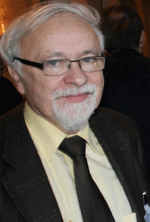
I am a Member of the Parliament for the Walloon Region which is one of the three regions of Belgium which became a federal state in 1993.
For 20 years, I have been the Mayor of the small town of Visé, 17 000 inhabitants, which lies halfway between the city of Liège in Belgium and the Dutch city of Maastricht which became renowned in Europe after the Treaty signed there in 1992 took its name.
Europe, a political concept which is hardly 50 years old, keeps developing more and more every day. However, the legislations of each of the States still differ a lot.
In that way, with regard to drugs, the Dutch decided to liberalize what were considered as soft drugs 40 years ago. They can be bought or consumed in places called ”coffee shops” where we can also have drinks.
If at first that liberty caused very little reaction, later the situation went on deteriorating. The free sale of cannabis attracted the presence of dealers of other toxic substances and an important number of unauthorized selling places developed.
The Dutch authorities do not know how to manage the problem anymore.
Let me add that also for the drugs considered as legal in the Netherlands, the authorities cannot control the situation, being unable, for instance, to determine the origin of the products for sale.
As the years go by, Maastricht has really become the place where a lot of consumers provide themselves with drugs. The number of narco- or drug tourists is estimated at 1.3 million.
However, Maastricht is not the only city that has opened ”coffee shops” and where the drug tourists travel to. But because of the geographical situation (it is nearly an enclave in Belgium) it is particularly attractive to the Belgians but also to the French who rush in large numbers to Maastricht.
Let me also point out that other towns have forbidden the presence of ”coffee shops” in their areas.
For us, the inhabitants of Visé, all those drug tourists crossing our town is clearly no advantage. But the worst is that our town has a few secondary schools with more than 4000 students living in our town or in the neighbouring communes and villages.
The situation has become unbearable for Maastricht which is a very pretty city where also a lot of non-addict tourists come and which has a lot of nice shops and famous restaurants.
The Mayor of Maastricht had then to choose one way or the other:
- either he solved the problem inhouse and decided to close down the ”coffee shops” with the risk of having problems with the government (as the law permits their existence)
or
he delocalized the ”coffee shops” very near the Belgian border and he chose this latter, more pernicuous solution.
This solution caused the opposition and the anger of the neighbouring Belgian Flemish and Walloon local authorities as well as the neighbouring Dutch ones.
A Dutch administrative court passed a judgement unfavourable to Maastricht, which delayed the realization of the political will of the Mayor of Maastrict.
However, he came back to the attack by adapting his project to the existing legalisation.
Faced with the anger of the neighbouring local council members, the Meuse-Rhine Euroregio association had a scientific study carried out by two university professors (a Belgian and a Dutch) who came to the conclusion that such a delocalization could not take place without the agreement of the neighbouring local authorities.
This study was hardly publicly known when the Mayor of Maastricht convinced his city council to go ahead without taking it into consideration.
And that is where we are now.
This conference goes beyond the simple statement or the denunciation: I am aware of it.
Preventive measures are the focus of your thoughts.
Undoubtedly we have long thought about the problem too.
The town of Visé has intensely developed and encouraged the practice of sport, as it, in addition to its original qualities, is also a weapon against drugs.
With the same intention we have invested a lot in the development of cultural activities in numerous ways.
We have also set up preventive warning campaigns against the consumption of drugs in our schools.
Recently we have opened a ”cannabis point” with the collaboration of the province of Liège with the aim of informing the parents as well as the students.
But beyond these preventive measures, the town of Visé’s membership of ECAD is a call for the solidarity of all European cities of which the managers and leaders are aware of the dangers of drugs.
We want to tell them that in the heart of Europe, there is a country and in that country, there is a Mayor who despises the youth of the towns and villages adjoining his own town.
We want to inform you against this contempt and see to it that our presence here can contribute to the protection of the young people of our town and of the neighbouring towns and villages.
We hope that one day, Mr. Leers, the Mayor of Maastricht, will become aware of the lives of the thousands of teenagers he endangers.
I put my hopes in the town of Visé’s membership of the European Cities Against Drugs, ECAD.
Thank you!