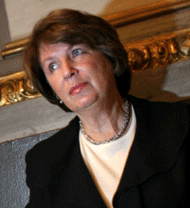
Today I do not only address you from my background as a scientist, but also as a person involved in a policy making at the White House.
We have a number of public health challenges that we face in our country and in the world. We have clearly attended to the reduction of the demand for drugs and offered intervention and treatment for drug users. But the real question is weather it has been practical.
So what are the solutions, what can the cities do?
Geographical proximity beats the differences in cultures, languages and your local drug policies.
We are very concerned about drug abuse in the USA, adolescent drug abuse above all. There are some people in our nation that believe that drug use is a pediatric disease. And the reason for this is that our youngsters begin to use drugs more likely, and the more likely they are to become addicted.
We also have a theory that the significant increase of prescription drug abuse, that is assumed, is possibly going to overtake marijuana use in our country.
History of prescription drugs starts in the 1990s with the complaints from patients, who had been treated with wrong medicine.
We want to look at the medical consequences and this is a critical piece, which I have not heard today and which I believe was not mentioned yesterday.
The strategy that I want to present to you is the involvement of medical professionals. It has been rare in the past to involve medical professionals, but drug use has decided many medical consequences.
Even though in the beginning of the XX century, in the early nineteen hundreds, transitions were intimately associated with our trying to develop policy to reduce drug abuse, they removed themselves the problems under the steer of influence over the past 30 to 40 years and it is time to bring them back into the picture.
I will present you a public health solution, a SBIRT (Screening, Brief Intervention, Referral to Treatment) program.
Brief intervention programs begin with a persons score; they pull the self-insight from the individual and the dialogue with medical professionals extracts persons` own judgments of the situation they are in. It offers clients a guide to how they should deal with the problem.
Click here the view the PowerPoint presentation by Prof. Madras, including statistics and SBIRT programme details!