| |
|
|
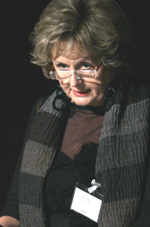
TRUDE H. DREVLAND
Deputy Mayor, Bergen, Norway
MAYORS` FORUM
II World Mayors`Conference on Drugs
(ECAD XVI Mayors’ Conference)
February 5-6, 2009
Göteborg, Sweden
| |
Honourable Mayors,
Ladies and Gentlemen,
In Bergen the situation regarding the use of drugs is followed through systematic surveys among the youth, 15 and 17 years old, and in the total population, made by the competence center the Bergen Clinics.
The recent results show us that the use of alcohol, tobacco and drug is decreasing among the youth. And to repeat what we already know: Most of our young population do not use drugs.
On the other hand, the few who try and continue to use drugs are faster addicted to hard drugs and develop severe problems in other areas of their lives.
Among adults, the use of alcohol is increasing, and also the amount of people who have used drugs. Especially the use of cocaine is increasing, while the use of heroin is decreasing.
Added up we don’t observe dramatic changes in the use of drugs in our city, but we certainly have challenges that need to be taken seriously and handled in an active way.
The City Council of Bergen will this month present a report on the situation in Bergen regarding the use of alcohol and drugs, and what themes and measures should be emphasized to reduce the problems we experience.
- First, we consider it very important to continue the work with prevention of the use of drugs, carried out in schools and local communities through systematic programs, and in cooperation between school authorities, health and social services, local police and organisations meeting young people on a daily basis.
In this work we have a challenge in bringing in updated local knowledge about the situation regarding dropout from school, crime, use of drugs and alcohol etc.
Further we need to emphasize the successful examples and inform about the experiences in the local communities. Knowledge-based drug prevention works, and we see the results.
- Secondly, we need to focus on the young people at risk of developing more severe problems.
We try to measure this by running educational programs for employees in schools, primary health care, social services and child care, to give them better knowledge to detect and intervene when they meet youths using drugs or showing other signs of misbehaviour.
In this work we will pay special attention on how to follow up people that have been under child care and who are about to live independent lives as young adults.
- Thirdly, we have the responsibility to maintain and develop a wide range of services for people with drug addiction, both harm reduction, rehabilitation and treatment. Our aim is to give help based on each person’s actual situation and possibilities.
A challenge is to be open-minded and pragmatic and search for new approaches and methods, and at the same time ask critically for what is evidence-based best practice.
Currently, we have a strong focus on the quality of medically assisted treatment, and securing that rehabilitation is a certain part of it.
We are also working to approve the cooperation between specialized treatment in institutions and the municipal services, and we participate in a Drug Court project.
The Health Ministry of Norway is as we speak talking about issues like handing out heroin to old drug users to prevent criminal acts and deaths. This is just now a big discussion in the socialistic government, but no decisions are made as yet.
In what way can we help each other in fighting drugs through cooperation
between cities and countries?
As I have mentioned earlier, I see a great challenge in making our approaches evidence-based. That means that we need networks between science, practice and policy makers, so we can emphasize knowledge and best practices, and thereby strengthen the possibilities of developing better services and treatment.
Here ECAD can play an important role by arranging national and international conferences, spreading new knowledge and examples of best practice on the website, and build networks that can be used in ongoing local process.
Thank you for your attention!
|
[Back]
|