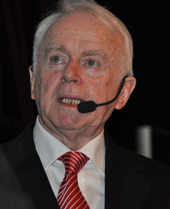
Ladies and Gentlemen, welcome to the conference!
At the outset, I wish to thank sincerely the City of Göteborg for hosting the 16th ECAD Mayors’ Conference and the 2nd World Mayors’ Conference.
This coming together of elected representatives of the people, professional officials, academics and NGO’s from distant parts of the world gives us all a wonderful opportunity to set out our ideals and objectives and to share our strategies and experiences in dealing with the real human problems arising from the misuse of drugs.
We are all committed to the ongoing task of understanding the complex dynamics of drug misuse and of responding, in a caring and non-judgemental manner, to the injurious consequences of drug abuse for people in our respective cities.
ECAD – 16 years on
ECAD is now sixteen years in existence and in the course of that time, ECAD has endeavoured to assist its member cities in acquiring knowledge of and implementing best practice initiatives to protect people from the curse of drug misuse and how to respond to the welfare of the unfortunate people who become addicted. Addiction has adverse effects not only on the individual person but on families and entire communities.
Other organisations
It is, of course, true to say that before the founding of ECAD and since its establishment other organisations with far greater financial resources have also been working to provide up-to-date information on the use of illicit drugs and how to combat drug abuse and illicit trafficking in drugs.
We have reports and analyses published by the European Monitoring Centre for Drug Addiction (EMCDDA).
This is a decentralised agency of the EU. and its role is to act as a central source of comprehensive information on drugs and drug addiction in Europe.
There is the Pompidou Group which at is 2003 Dublin Ministerial Conference agreed a structure for the work of the group based on six platforms – prevention, treatment, criminal justice, research, ethics and airports.
Then there is the involvement of the International Society for the Study of Drug Policy (ISSDP) which was founded in 2007 with the aim of developing relations among drug policy analysts and providing a forum for high-quality drug policy analysis, developing the scientific base for policy decisions, and improving the interface between researchers and policy makers. Each of these organisations is engaged in essential work.
Dialogue
I take this opportunity to appeal to the aforementioned organisations i.e. EMCDDA, Pompidou Group and ISSDP to enter into dialogue with ECAD for the purpose of reviewing the problem of drug misuse and drug addiction in Europe with a view to sharing the most up-to-date information emanating from research and identifying best practice in the economic and social conditions of these, the infant years of the 21st Century. I do so in the firm belief that progress can be made in engaging, not just policy researchers and policy advisers in face to face deliberations about drug policy options, but also the decision-makers, namely politicians.
ECAD – Review
It behoves every international organisation to continually examine the reason for its existence and the role it is playing or failing to play in the world of today.
The meeting of the Advisory Board of ECAD, held in Cork in October 2008, devoted the entire day to reviewing our mission statement as an international organisation and how we should strive to advance the aims of ECAD now and in the immediate future. What can be done for our member cities? And how can we persuade many other European cities to be part of ECAD`s crusade against illicit drugs?
It was a highly stimulating debate, with many highly-qualified experienced people, expressing their wishes with passion and clarity.
A Strong Voice
One ideal which was totally unanimous and unambiguous in its content, was that ECAD must continue to be a strong voice in Europe which rejects all efforts to decriminalise the sale of and the use of illicit drugs.
Human Right?
In recent years, the argument that the use of drugs is a human right is continually being expressed. We all support the recognition of individuals’ human rights, within the context of the prohibitionist framework.
In 2004, the Council of the European Union made explicit reference to human rights, among other matters, in the preface to the EU Drugs’ Strategy for 2005- 2012.
”This new Drugs’ Strategy is based first and foremost on the fundamental principles of EU Law and, in every regard, upholds the founding values of the Union, respect for human dignity, liberty, democracy, equality, solidarity, the rule of law and human rights. It aims to protect and improve the wellbeing of society and the individual, to protect public health, to offer a high level of security for the general public and to take a balanced integrated approach to the drug problem”.
In short, ECAD will continue to be a strong voice against any movement to decriminalise the use of illicit drugs.
Different Approaches
We also agreed, at our Cork Meeting, that ECAD must demonstrate its respect for and acceptance of different approaches to the drug problem in some cities and that we are prepared to work with all cities in the best interest of people.
Financial Constraints
ECAD is an international organisation with very limited resources in terms of finance and in the number of professional people we can afford to employ.
With regards to finance, we are deeply indebted to the generosity of the City of Stockholm for the funding and facilities it continues to provide for ECAD.
While we have some 270 cities in the membership of this international organisation, we do experience great difficulties in getting modest membership fees from a large number of cities.
We strive to balance our income against numerous financial commitments which ECAD is engaged in across Europe, e.g.
- We have an ECAD Balkan office and Director in Bourgas, Bulgaria which is
successfully expanding its influence among a network of cities and towns.
- ECAD has an office and Director in Latvia which is very active in pursuing
the ideals of this organisation.
- ECAD has an office and Director in St. Petersburg, Russia. We have been
using funding from the Swedish International Development agency to develop and strengthen the Russian network.
- ECAD is one of the organisers of the Conference and Fair – ”Sweden
Against Drugs” – which is one of the biggest national manifestations of
Swedish drug policy.
- ECAD is striving to assist the ”Youth in Europe” project – a drug prevention
programme which was launched in 2005 and is coordinated in a most professional manner by our associates from Reykjavik.
Some of our member cities keep in close contact with ECAD`s Head Office in Stockholm, others never contact us. While we are always available to advise cities in their drug strategies, we do not have the capacity to run drug projects in any one city.
Coordination
The illicit drug problem is indeed a complex problem requiring responses from a wide range of different organisations operating across a range of different sectors. To ensure effective implementation, coordination of efforts is a critical requirement. Coordination has been accorded a prominent status in international drug policy documents, including the UN Action Plan for the implementation of the”Declaration on the Guiding Principles of Drug Demand Reduction” (UN 2000: Objective 2) and the EU Action Plan on Drugs 2000 – 2004 (Council of the European Union 2000: Action 1.3.1).
I believe that coordination of effort by statutory agencies and voluntary and community groups is best achieved in a city or town context.
A City Strategy
At our Cork meeting, we decided to appeal to our member cities, for each city to set-out an overall strategy, to significantly reduce the harm caused to individuals and society by drugs misuse and to do so through a concerted effort on four activity ”pillars”:
- Supply Reduction
- Prevention
- Treatment & Rehabilitation
- Research
To ensure that a sense of urgency and momentum drives the implementation of the strategy, specific objectives should be set our under each of the four pillars and dates set for a review progress. For example, under the Pillar of Prevention, one could set objectives such as:
- Generating awareness of the dangers associated with drug use
- Educating people with regard to drug misuse
- Mitigating personal circumstances or broader socio-economic and cultural conditions believed to contribute to drug use
- Increased educational and training opportunities and employment prospects
To establish and drive such a strategy will indeed require active and ongoing cooperation between statutory agencies such as the police, health authorities, education providers but, it should also include community and voluntary groups to work hand-in-hand with state agencies.
We should not underestimate the power and determination of local communities when their quality of life is being diminished by people who supply dangerous drugs and, in the process, are devastating innocent lives and destroying families and communities.
Example
In recent times, in Blanchardstown, a suburban area on the outskirts of Dublin, a coalition of Community Groups, launched a campaign entitled ”Dial to Stop Drug Dealing”. It grew out of peoples’ frustration at the growing problem of drug dealing. The main purpose of the campaign is to gather information about drug dealing and make sure it reaches the police.
The project was initially set-up as test to run for six weeks. However, due to its success, it has been extended.
To date, the Campaign has been deemed very successful in assisting the police to gather intelligence about drug dealing in that area and led to a significant number of arrests.
I will be launching the ”Dial to Stop Drug Dealing” in Cork next week. We can all learn from one another.
Resilience
It is so easy to become frustrated when you are engaged in the ongoing battle to protect people from the dangers of illicit drugs.
I never cease to be amazed at the sense of vocation and resilience of the men and women who operate drug-prevention programmes in my City.
Let us take hope and courage from the prophetic words of a man of peace, Gandhi, who said:
”There have been tyrants and murderers and, for a time, they seem invincible, but in the end, they always fall”.
We will succeed in protecting ever increasing numbers of our citizens from the dangers arising from illicit drugs and we will bring hope and rehabilitation for those who succumb to addiction.
Let us, this morning, at a conference which will benefit from the wisdom and experience of a cross-section of people involved in the task of confronting drug abuse, salute the youth workers/drug workers – who work through unsocial hours in our cities and towns to protect young people. Particularly young people who are often vulnerable to the machinations of unscrupulous drug dealers and in so many cases these youth/drug workers guide many young people through the rebellious teenage years.
The task of the youth workers may not be seen by society as being high up the academic ladder, but they provide a vital service which is of incalculable value to so many people who may drop out of the mainstream education and eventually be found drifting on the margins of society. Research and academic papers in the question of drug abuse are very important but equally important are the workers in the streets.
[Back]