Distinguished delegates,
Ladies and gentlemen,
First of all I would like to thank you for the kind invitation to speak at this important Conference on Drugs as a representative for the civil society. I would also like to congratulate ECAD who organised the event, and the city of Göteborg for hosting this very important Conference.
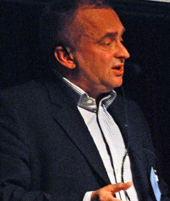
My name is Sven-Olov Carlsson, and I am here today in my capacity as President of IOGT International. IOGT International is a worldwide community of non-governmental organisations. Our objective is to work in the field of drug policy and prevention. IOGT International is a member of the Vienna NGO Committee and a member of the Committee’s Board since October of last year.
Before I was elected as International President I was working as a City Manager in Sweden for almost 20 years so I am quite familiar with local governance and local politics in Sweden.
There are few places on earth that can be considered ‘remote’ anymore. Long-distance travel that used to take weeks or months is now just a few hours away by airplane. The world is industrialising at an ever-increasing rate. It is estimated that by 2030, 61% of the global population will live in urban areas, many of them in so-called ‘super-cities’ of 20 million or more people. Tokyo or Mexico City will no longer be the exception; many of these huge conglomerations will be in the developing world. Historically mass migrations from the countryside to cities have resulted in the creation of slum areas, social deprivation and environmental damage.
Television and radio programmes can reach people even when roads cannot. In fact, they are regularly used to pass health education messages to rural groups. Mobiles phones, once the fashion accessory of the business elite, have become everyday tools to link communities. But there are other aspects to this situation as well where the modern technology can be used for negative aims.
Not everyone has benefited equally from globalisation. The emergence of transnational corporations that dominate global markets has resulted in startling inequalities.
Of the world's 100 largest economic entities, 51 are now corporations and 49 are countries. Three quarters of the world’s top 200 corporations are based in the industrialized countries. They account for more than one quarter of global economic activity while employing less than one percent of its workforce. Those same corporations have annual sales of 18 times the size of the combined annual income of the 1.2 billion people (24 percent of the total world population) living in "severe" poverty.
Drug abuse is a global problem. Millions of people are directly harmed by drug abuse, not only drug users and addicts, but also their parents, relatives, friends and employers as well as the victims of drug-related crimes. Communities that live in areas where illicit drugs are grown or sourced also suffer harm from global drug abuse because their social, political and economic development is hampered by the drug trade.
Various actions are taken internationally to counteract the social, economic, health, spiritual and crime problems caused by drug abuse. The fight against drug trafficking and drug abuse has strong support not only by the UN Conventions but also by governments all over the world. Some organizations and local governments in many countries actively advocate, however, the legalization of drugs or promote policies such as “harm reduction” that do not include any ambition to help drug users to become free from drugs. Instead drug use is accepted. This undermines the international efforts to limit the supply of and demand for drugs. “Harm reduction” is too often used as another term for drug legalization or other inappropriate efforts to relax the control of illicit drugs, thus violating the UN Conventions.
There can be no other goal than a drug-free world. Such a goal should not be rejected because it is supposed to be impossible to reach. Too often, policy goals are set according to what is considered possible, rather than what is necessary or desirable for optimal human development for all people.
Communities that live in areas where illicit drugs are grown or sourced also suffer harm from global drug abuse because the drug trade hampers their social, political and economic development.
Drug trafficking impacts most heavily on some of the world’s poorest communities, undermining efforts to support their positive development and destroying local cultures.
This is the environment and the realities we have to face when we talk about Drug Abuse Prevention.
The essence of living together in cities is learning how to share, cooperate and compromise. As a community we share responsibility for:
- Neighbourhoods: homes, public spaces: parks, leisure and entertainment centres
- Public services: transport, utilities, police
- Safety and security in public and private spaces
- Economic growth: offices and workplaces
- Learning in schools, educational institutions
- Solidarity through welfare and social services, housing and care facilities
Human beings cannot exist in isolation. We live together in families, social networks and communities. We invest in each other and our relationships; we value and maintain our connections.
In order to have our needs met, we rely on each other for love, affection, support, care and understanding. Our society is therefore based on complex interactions and dependencies.
Cities are the environments where these relationships happen.
Drugs undermine all of these interactions.
Drugs distort an individual’s decision-making process, limiting the ability to care for oneself or others.
Drug abuse overrides or replaces healthy social interaction, undermining the fundamental relationships within society.
All aspects of drugs result in widespread harm, from cultivation, production, transport, distribution and consumption.
Drug prevention work has a strong interaction with other drugs, above all alcohol and tobacco. Use of different drugs often occur together, with shared mechanisms of dependence and the resulting harm often comes from combined misuse of several substances. People who die from an overdose often have large quantities of alcohol and legal drugs in the blood.
It is therefore very important that prevention is not directed towards one group of substances, but involves joint action against alcohol, tobacco, drugs and doping.
Sweden was the first country in Western Europe to have a large-scale drug problem among young people, in the middle of the 1960s.
The problem with abuse of illegal drugs was new in our country and very few people knew anything about it. During this period drug abuse levels rose year after year and became more and more alarming.
In the 1960s, Sweden practiced very liberal drug politics. The police didn’t bother doing anything against people having up to 10 or even 20 grams of cannabis in their pockets. So the street selling of cannabis was left alone.
The turn to stricter drug politics came in the late 1970s. The official politics and the legal practice had been criticized and debated by many people and organizations during the later half of the decade.
The turning point came in 1980 when the Prosecuting General sent out directions to the local prosecutors stating that every possession of illegal drugs should be taken to court and not written off as had been the practice for many years with the smallest crimes of possession.
The police started organizing their work in a different way, setting up special units fighting the small scale trafficking of drugs and also bringing people to court for possession of even the smallest quantities of narcotic drugs.
During this period there was also quite a lot of money invested in treatment for drug addicts. It was quite easy to get help to get away from drugs. There was also a lot of propaganda in schools against drugs.
In 1984, NGOs in the drug field wrote a petition to the government and asked people to sign it. The petition demanded that there should be a law against consumption of narcotic drugs. Nearly half a million signatures were gathered during a few months, which were far more than expected. At the same time an opinion poll showed that 95% of the people supported the idea to make consumption illegal. Sweden had around 8 million inhabitants in 1984.
The petition was handed over to the government but the response was negative. The government would not make consumption illegal.
Some of the other political parties in the Parliament started campaigning to make consumption illegal and in 1988 the government was pressed to make a law that criminalized consumption.
However, the law proved to be ineffective since the police did not have the right to take urine or blood tests as evidence. The new liberal/conservative government made changes in the law in 1993 so the police would have these rights. Today the police use the law against consumption quite actively.
Sweden went from a very liberal position to one of the strictest in Europe. The major factor in the process was that public opinion demanded this and that various organizations were very active in expressing what people thought about these matters. Step by step politicians listened to what people asked for and adjusted politics after this. The role of public opinion cannot be overrated when one looks at how Sweden developed its current drug politics.
In United Nations Office on Drugs and Crime report, with the title “Sweden’s successful Drug Policy: A review of the evidence” from September 2006 there are a lot of statistic documentation which shows that Sweden perform very well from an international point of view.
Some statistics are of particular interest.
When they in a survey called “The European School Survey Project on Alcohol and Other Drugs” – ESPAD 2003 ask 15-16 years old teenagers if they think they put themselves in big danger if they are smoking cannabis, answered 83 percent “yes” in Sweden.
In Great Britain 46 percent answered “yes”.
In the same survey 1 (one) percent of 15-16 years old teenagers in Sweden answered that they have smoked cannabis the last 30 days.
In Great Britain 20 percent acknowledged that they had done it.
That means that every fifth teenager is smoking cannabis in Great Britain.
To conclude: the general consciousness and knowledge regarding the dangerous with drugs are connected to the drug policy in general in the society. The restrictive model combined with active education/information is a successful recipe.
There are some important factors to take in consideration when one should form preventive policies against drug abuse in a town, a region or a country. Some of the more important experiences and principles are the following:
- We have realized that the spread of drug abuse occurs among friends, usually very close friends, and especially shortly after initiation.
- We have realized that the motivation for treatment is usually quite low and comes after several years of abuse.
- We have realized that treatment is not very effective. It is difficult to cure more that 10-20% of the patients.
- We have realized that information alone is not very effective at preventing drug abuse. It must be combined with other activities such as control and treatment.
- We have realized that there is no conflict between control measures and supporting measures. Police, social workers, doctors and teachers can work well together.
- We have experienced that by focusing on the small crimes and early detection it is possible to keep young people away from this problem. And this is where the key to success lies.
In 2003, the world’s first global treaty on health was signed. The Framework Convention on Tobacco Control (FCTC) took 4 long years of negotiations between the 191 member countries of the World Health Organisation. The most important feature of the FCTC is that it covers all aspects of tobacco, ranging from health warnings on the packets to the advertising, promotion and sponsorship activities of tobacco companies. In addition, the treaty sets out measures to control the sale of cigarettes to minors and to tackle smuggling. Attention is also given to supporting farmers to diversify their crops and to find other ways of earning a living than growing tobacco. Basically, the treaty covers the whole cycle of tobacco from the plant to the end product. It is the foundation of a global commitment to a comprehensive strategy to combat tobacco. It links together elements of supply and demand.
As you can imagine, finding a balance between all the competing interests of the countries was a real challenge. The World Health Organisation maintained a strong political commitment and complete focus during all of the slow and sometimes painful negotiations. To support the WHO, the health community united around the process. A special coalition of Non-governmental organisations shadowed the negotiations, keeping up the pressure on the governments and monitoring and exposing attempts by the tobacco industry to infiltrate national delegations or influence the debate.
The Framework Convention on Tobacco Control is a good example what can be achieved when committed non-governmental organizations cooperate and work together.
Why is the work of non-governmental organizations so crucial for success when it comes to drug prevention?
- It’s for fact that non-governmental organizations (NGOs) support and reinforce social connections between people.
- They build stronger and more resilient societies, upholding the key values of cooperation, solidarity, human rights, justice and equality of opportunity.
- They give communities a voice, particularly those without political or economic power, which suffer disproportionately from global drug abuse.
Drugs always involve harm and have no place in a vision of healthy societies and vibrant cities.
Therefore there is a need for like-minded Non-governmental organizations and the community to work more together to counteract pressure to liberalize drug policy.
Policy-makers at all levels need an awareness of the harm of drug abuse. NGOs have an important role to play in this matter.
Non-governmental organizations have a number of assets:
- First of all, many of us share similar fundamental values and are all committed to working towards the same aim.
- We also enjoy significant levels of public trust and confidence. A number of surveys have consistently shown that Non-governmental organizations are considered more trustworthy than governments or industry.
- Non-governmental organizations have the capacity to work together in a collaborative way. By sharing information, ideas, advocacy tactics we can move the global agenda forward.
Globalization can also work in our favour. As Non-governmental organizations we can influence the political, social and economic environments internationally. The Tobacco case I mentioned earlier is a good example of that. And we can hold governments accountable for their policy decisions at home and abroad.
The strength of the international drug control system is its universality, with all governments solidly behind the United Nations drug conventions.
But drug policies are too important to be left to drug experts and to governments alone. It is a society-wide responsibility that requires society-wide engagement. This means working with children, starting from parents and teachers, to ensure that they develop self-esteem. This means to support family-based programmes, because prevention begins at home. This means advocacy.
People can be steered away from drugs. And those that do suffer the misery of addiction can be brought back into society. This is the true meaning of harm reduction, which goes far beyond its usual narrow definition.
We all want to help farmers to switch from crops to sustainable livelihoods.
We all want to help the drug addicts – to save them from a life of misery. And in that regard we must provide appropriate evidence-based treatment for drug abusers that have a goal of helping people to become drug free, and
We all want to reduce the violence and crime associated with the drug economy.
My key message is:
Human rights are incompatible with drug abuse. All individuals have the right to a life that is not harmed by drugs. Policy-makers need to defend and protect this right. The rights and interests of drug users are not served by supporting the continuation of drug abuse.
Alcohol, tobacco and drugs are phenomena that affect every geographic region in the world and no country can tackle these problems alone. To have any impact, there has to be a consistent approach to these products and this means creating strong coalitions that can help both national and local governments to find the political will to act.
Some years ago eleven Swedish non-governmental organizations, all working to reduce drug abuse and stop drug trafficking, decided to undertake a challenge to plan for the first World Forum Against Drugs.
One of our major goals was to reach out to non-governmental organizations on all continents and invite their members to a world conference on drugs where they could share experiences and talk about a vision of a drug free world.
The Conference took place in Stockholm in September last year and gathered more than 600 committed participant from more than 80 countries – an outcome much better than we ever could have hoped for.
One outcome of the Conference is that we are now preparing the launch of a global network of Non-governmental organizations – A world federation against drugs - which are united in support of the United Nations conventions. Another outcome is that there will be regular, global Drug-Free World conferences in the future.
<
ECAD is a very important, constructive and established stakeholder in fighting drugs. We look forward to further co-operation with ECAD in this matter.
To conclude:
- Effective policies on drugs have to address prevention as well as treatment and care. And policies need to focus on the societal wellbeing rather than individual interests.
- Non-governmental organizations can be very important partners in implementation of policies on drugs, particularly for prevention.
- Non-governmental organizations help to create a supportive environment for a policy and institutional framework to tackle drugs, and
- Local governments can ensure that non-governmental organizations have the financial resources and policy space to act effectively.
Thank you for your attention!