| |
|
|
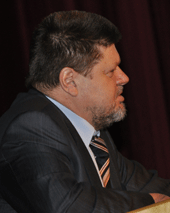
Evgeny A. Bryun,
Director,
Centre for Research and Practice on Addictions, Department of Public Health, Government of Moscow, Russia
"Preventive measures on addictions: strategy and methods of work. Experience of the City of Moscow"
ABSTRACT
ECAD XVI Mayors’ Conference
February 5-6, 2009
Göteborg, Sweden
| |
Efficiency of treatment and rehabilitation in addictions (measured in abstinence during 12 months) depends directly on a number of steps of treatment procedure a patient has handled.
Thus, pure detoxification produces remissions in 1-5% cases, while detoxification and treatment of psychopathology bring patients about in 15-20%, addition of psychotherapy delivers remission in 25-30%, and involvement in rehabilitation makes it successful in 30-40%.
We have developed a technological sequence of measures (programs) aimed at recovery of addicted persons’ mental development and decreased demand for psychoactive substances. This technology includes seven stages of prevention, treatment and rehabilitation of psychoactive substance abuse:
- Primary prevention: working with families and organized groups including pre-school children and provision of information.
- Secondary prevention: working with risk groups, neglected children and persons with behavior problems. Interaction with families and organized groups.
- Intervention: first consultations for patients and their family members; motivating patients enter treatment program.
- Detoxification: treatment of withdrawal symptoms, and also somatic, neurological and acute psychopathological disorders.
- Treatment of pathological craving, affective and other disorders, both before the illness and those associated with chronic use of psychoactive substances.
- Psychotherapy and correction of personality disorders.
- Rehabilitation and prevention of relapse programs: medical observation and formation of rehabilitative environment. Interaction with the family and contacts with other organizations and agencies involved in patient’s support.
Every stage of this treatment and rehabilitation process includes development of structural units responsible for implementation of specific tasks and also provision of continuity and consistency of care.
Thus, introduction of system approach into treatment and prevention of addictions becomes a special characteristic of modern drug treatment care in the city of Moscow.
About Moscow Research and Drug Treatment Center
- The Centre is a state financed institution for scientific and medical purposes for 565 bed places.
- Treatment of various kinds of addictions is free of charge, including inpatient and outpatient rehabilitation treatment programmes.
- There is also a day-treatment care department, and all treatment can be up to 6 months long.
- Patients are enrolled into rehabilitation treatment programmes on the voluntary basis only. They can also leave it and quit the programme any time they like.
- The Centre has a separate department for HIV-AIDS patients, who are admitted after they have been redirected to the Moscow Research and Drug Treatment Center from the Moscow City Centre for HIV-AIDS Treatment.
|
[
Back]
|