Ladies and Gentlemen, welcome to the conference!
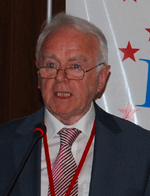
It is my honour and pleasure on behalf of the Advisory Board of ECAD to welcome the delegates to this, the 15th Annual Mayors’ Conference.
The Mayors Conference is the supreme decision making agent in this international organisation.
We must at the outset express our sincere thanks to the city of Warsaw for hosting the 2008 Conference and for engaging in a great amount of preparatory work so that we might hear from a range of experienced and highly informed speakers.
This historic city has experienced over the centuries a history of endeavour of happiness and sorrow but the spirit of the people of Warsaw was always focused on progressing of the welfare of all its inhabitants irrespective of race, creed or political outlook.
ECAD is driven by the same ambition to respond to the needs of people who are vulnerable to the machinations of the drug pushers and also respond to the needs of the unfortunate people who become addicted to drugs and must be assisted so that they may return to full participation in their community.
The delegates to this Mayors’ Conference are predominantly public representatives and public officials who are well aware of the severity of the drug problem in their cities and towns.
Just as we would strive to improve the welfare of our citizens through the provision of good housing, the provision of employment opportunities, the provision of educational and training centres and the provision of recreational and cultural facilities so too we must strive to protect our citizens from the horrible consequences of illicit drug experimentation and to provide up-to-date medical facilities for those unfortunate people who become addicts.
Illicit drugs are a plague which is destroying individual persons, families and entire communities.
We public representatives should not stand idly by in the hope that this insidious social affliction will go away of its own accord.
ECAD is now 15 years in existence and we must ask ourselves continually are we making progress?
Are we focusing our efforts and our limited resources in the right direction so that the commitment of many people across Europe who believe in the ECAD crusade is bearing fruit?
I can assure this Conference that the Advisory Board is not a cosy complacent club but a group of well informed people who constantly engage in self-evaluation as to how we are steering this international organisation.
As recently as the 1st February we spent an entire day in Stockholm teasing out relevant issues such as:
- how do we continue our campaign against the legalisation of drugs;
- how do we demonstrate our respect for and acceptance of different approaches to the drug problem in other cities/countries;
- how do we convince all member cities to pay their membership fee so that ECAD will have funds to expand its role and engage in research;
- how do we convince more European capitals that they have a role to play in ECAD;
- how do we acknowledge our deep appreciation of the generosity of the city of Stockholm and strengthen our role as an international organisation.
The Mayors’ conference is the opportunity for you, the representatives of cities and towns from across Europe, to let the Advisory Board know how you evaluate our performance.
My Annual report as Chairman which has been circulated will be on the agenda for the ECAD Plenary Session, gives member cities a summary of the coordinating activities which your executive team have been engaged in over the past year.
In this regard I want to thank Tomas Hallberg for his commitment and loyal service to this organisation. Tomas was director from 1999 to March this year.
During that period he travelled all over Europe and further afield to promote the message of ECAD and to initiate and oversee the growth of this international organisation.
We wish Tomas happiness and success and self-satisfaction in his new position in the commercial world.
Since the resignation of Tomas in March Åke Setreus has been the acting director and has been doing so most efficiently and he will continue to act until August when the newly appointed director - Jörgen Sviden - will take up his duties as director of ECAD.
Moving away from organisational matters I wish to share with this Conference a suggestion on policy/strategy.
As public representatives we share a duty to be continually exploring possible ways by which we can improve the quality of life of people on our streets and in our housing estates. In many cities in Europe life for families and elderly is very unhappy because of the influences of drug pushers.
I would respectfully ask mayors and deputy mayors to consider now preparing a five year strategic plan that will seek to respond to the drug issues in your cities and towns.
Perhaps if we all in our respective cities were to ask ourselves three questions:
- Where are we now in our fight against illicit drugs?
- Where do we want to be?
- How are we going to get there?
As we tease out such questions we quickly realise that tackling illicit drug consumption is ultimately about users, their families and their communities and not primarily about service providers.
The most recent research in my country indicates that a multi-agency approach to, at least alleviating to drug problem, is essential.
Service providers must work very closely together if we are to make progress
- in reducing the flow of illicit drugs
- in reducing the demand for such drugs
- in responding to the needs of people who experiment and in too many cases become addicts.
I would respectfully recommend that cities and towns would establish Local Drug Task Forces which would bring together regularly the main providers of services e.g.:
- the police and custom officials
- the education and training providers
- the health authorities and above all
- representatives of local communities.
Such a Task Force would work under the aegis of the City or Town Council and it should build its strategy around five pillars namely:
- supply reduction
- prevention (including education and awareness)
- treatment
- rehabilitation – continuum of care
- research.
In December 1948 – sixty years ago this year – the General Assembly of the UN adopted and proclaimed the Universal Declaration of Human Rights.
The UN established a legal framework that asserted the dignity, equality and inalienable rights of all members of the human family.
This Declaration implied that all people are entitled to achieve free and meaningful participation in economic, social, cultural and political development.
We know that thousands of drug addicts in our European homeland have been robbed of that participation and inclusion in their societies because illicit drugs have destroyed their minds and bodies.
Is it not appropriate that 60 years after the UN Declaration of Human Rights as we gather in the historic city of Warsaw with its proud record of commitment to the welfare of all sections of its society we should renew our commitment to protect our people from the dangers of illicit drugs and help those who have succumbed to addiction to be restored to a quality of life befitting a human being.
Dealing with the drug problems requires great commitment, energy and endurance on the part of all of us who wish to rid society of this running sore which is disfiguring the face of local communities all over Europe. Let us continue to fight the goof fight.
A famous Lord Mayor of Cork – Terence McSwiney who died after a hunger strike last 73 days wrote
“Victory is won not by those who can inflict the most, but by those who can endure the most.”
It is in that spirit - a spirit of confidence inspired by a clear vision that ECAD will move into its 16th year of service to people who need our help.
[Back]